What Is SFP in Networking? Modules, Ports & Types
What is SFP, exactly? SFP stands for Small Form-Factor Pluggable, a compact, hot-swappable transceiver that plugs into a switch's SFP port to turn a single slot into a copper or fiber link. It's the industry-standard interface that lets network engineers choose connection media after installation, matching each port to the speed and distance the deployment actually needs.
This article covers how SFP modules and ports work, the full range of types from 1G through 100G, common SMB deployment scenarios, and how to choose the right module for your network.
Key Takeaways
- SFP stands for Small Form-Factor Pluggable, an industry-standard hot-swappable transceiver governed by a Multi-Source Agreement (MSA), so modules from different vendors work across compatible switches.
- SFP modules deliver 1 Gbps, SFP+ delivers 10 Gbps, and SFP28 delivers 25 Gbps using the same compact footprint with distinct electrical signaling rates, while the 100G QSFP28 requires its own distinct cage size.
- Fiber SFPs extend gigabit and 10G links well beyond copper's 100-meter limit, reaching up to 550 meters for multimode short-reach and 10 kilometers or more for single-mode long-reach.
- Common SMB use cases include switch-to-switch uplinks, building-to-building fiber runs, 10G backbones in multi-gig networks, and extending connectivity to remote IP cameras or access points through media converters.
- Omada covers the full stack, with switches that include SFP, SFP+, and SFP28 ports, a catalog of 1G through 100G modules and direct attach cables, and media converters to bridge copper and fiber in mixed deployments.
What Does SFP Stand for in Networking?
SFP stands for Small Form-Factor Pluggable. It's a compact, hot-swappable transceiver standardized through the SFP Multi-Source Agreement (MSA). The MSA is a shared specification among hardware manufacturers, meaning modules from different vendors operate correctly in any MSA-compatible switch cage. This interoperability is important because it means IT teams aren't locked into a single supplier when sourcing replacement modules or expanding capacity.
SFP modules are sometimes called Mini-GBIC, a carry-over from earlier Gigabit Interface Converter technology. The Mini-GBIC name still appears in vendor documentation and product listings, so you may encounter both terms when sourcing modules.
What Is an SFP Module?
An SFP module is the removable transceiver that slots into an SFP cage on a switch, router, gateway, or media converter. The port and the module are two separate components: the port is a permanent slot built into the device, while the module is the field-replaceable transceiver that determines whether that link runs over fiber or copper.
On the host side, an electrical edge connector on the module slides into the switch cage, plugs into the internal socket, and locks into place. On the network side, the media interface connects to an LC duplex fiber connector or RJ45 jack, depending on the module type. Modules can be inserted or removed while the switch remains powered, without interrupting other ports.
Anatomy of an SFP Module
The key physical components are the media connector (LC duplex or RJ45), the internal optics (such as a laser diode) for fiber variants, the PCB edge connector, a bale clasp, and the metal housing. Most modern modules also include Digital Diagnostic Monitoring (DDM). DDM reports real-time link metrics to the switch management interface, including transmit and receive optical power, temperature, and supply voltage. This lets administrators check fiber link health and troubleshoot degraded signals remotely without touching the cable plant.
How an SFP Port Works in a Switch
A switch's SFP slot provides one configurable port, and its behavior is determined by the module installed. Port speed is determined by the slot type, not the module alone: an SFP slot accepts 1G modules; an SFP+ slot supports 10G (and is backward-compatible with 1G on most switches); and an SFP28 slot supports 25G and typically also accepts 10G and 1G modules.
This backward compatibility is why many multi-gig access switches ship with SFP+ slots that can run either a 10G uplink or a 1G fiber extension, depending on what the deployment requires. Omada switches like the SX3008F (8× SFP+) or SX3206HPP (four 10G PoE++ copper ports with two 10G SFP+ slots) expose SFP+ slots for aggregation uplinks and backbone connections.
Types of SFP Modules
The SFP family spans a wide range of speeds, media types, and distance profiles. The main types are:
- SFP (1 Gbps): Gigabit modules for copper RJ45, multimode fiber, single-mode fiber, and single-fiber WDM links
- SFP+ (10 Gbps): 10G modules for multimode fiber, single-mode fiber, copper RJ45, and direct attach copper (DAC) cables
- SFP28 (25 Gbps): 25G modules for multimode and single-mode fiber, and 25G DAC cables
- QSFP+ / QSFP28 (40G / 100G): Quad Small Form-Factor Pluggable modules using four lanes for high-density aggregation uplinks
- Industrial SFP: Ruggedized modules rated for extended operating temperatures, used in factory, outdoor, and transportation environments
- Direct Attach Copper (DAC) cables: Fixed-length passive copper assemblies with SFP+, SFP28, or QSFP28 connectors on each end for short-reach stacking
SFP (1 Gbps)
Standard gigabit SFP covers four variants. 1000BASE-T runs over copper RJ45 up to 100 meters, useful where fiber isn't available. 1000BASE-SX uses multimode fiber and reaches 550 meters. 1000BASE-LX uses single-mode fiber and reaches 20 kilometers. 1000BASE-BX uses wavelength-division multiplexing (WDM) to carry traffic on a single fiber strand up to 20 kilometers, which is useful where only one fiber is available.
Omada 1 Gbps modules include SM331T (copper), SM311LM (multimode), SM311LS (single-mode), SM321A/SM321B (BX WDM), and SM321A-2/SM321B-2 (BX WDM). For deployments with temperature extremes, the ISM-series industrial modules ISM311LM and ISM311LS cover the same multimode and single-mode distances at an operating range of -40 to 85°C (-40 to 185°F).
SFP+ (10 Gbps)
SFP+ uses the same physical form factor as SFP but operates at 10 Gbps. 10GBASE-SR covers multimode fiber up to 300 meters on OM3. 10GBASE-LR reaches 10 kilometers over single-mode fiber. 10G WDM (BiDi) modules support bi-directional communication over a single strand of single-mode fiber. 10GBASE-T runs 10G over Cat6a copper up to 30 meters, making it practical for short server room runs. SFP+ DAC cables support switch stacking and top-of-rack uplinks at 1- and 3-meter lengths.
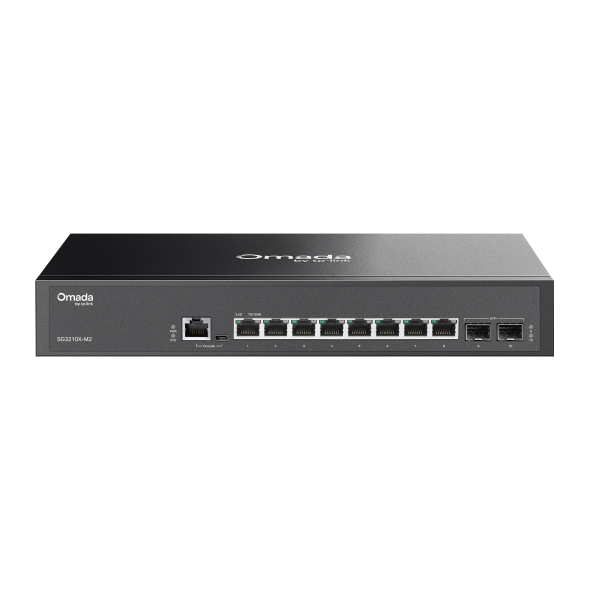
SFP+ slots are also backward compatible with 1G SFP modules, which is why switches like the SG3210X-M2 can use the same SFP+ slots for either a 10G uplink or a 1G fiber extension.
Omada 10 Gbps modules include SM5110-SR (multimode), SM5110-LR (single-mode), SM5110LSA-10/SM5110LSB-10 (WDM BiDi), SM5310-T (Cat6a copper), and SM5220-1M and SM5220-3M (DAC cables).
SFP28 (25 Gbps) and QSFP28 (100 Gbps)
SFP28 uses the same form factor as SFP+ but operates at 25 Gbps per lane. It covers multimode fiber at 100 meters and single-mode fiber at 10 kilometers. A 25G SFP28 DAC cable handles short-reach stacking at 1 meter. QSFP28 scales to 100 Gbps across four 25 Gbps lanes, using an MTP/MPO-12 connector on parallel multimode fiber, reaching 70 meters on OM3 and 100 meters on OM4 at 100G, or up to 150 meters on OM4 at 40G. A QSFP28 DAC cable is available for very short stacking runs.
For most SMBs, SFP28 and QSFP28 are a forward-looking investment for environments where 10G uplinks are approaching saturation.
Omada modules in this collection include SM6110-SR (25G multimode), SM6110-LR (25G single-mode), SM6220-1M (25G DAC), SM9110-SR4 (100G QSFP28), and SM9220-1M (100G QSFP28 DAC).
Industrial SFP Modules
Industrial SFP modules match the standards and distance profiles of commercial variants but are built for environments that would degrade standard hardware. The key difference is the extended operating temperature of -40 to 85°C (-40 to 185°F).
Omada's industrial lineup includes the ISM311LM (multimode), ISM311LS (single-mode), and ISM321A-20/ISM321B-20 (BX WDM) for factory, outdoor, and transportation deployments.
SFP vs. SFP+ vs. QSFP: What's the Difference?
SFP, SFP+, and SFP28 share the same compact physical housing, so a module from any of these three will slide into the same cage.
However, compatibility is determined electrically, not physically: a 1G SFP cage cannot process the high-frequency signals of a 10G SFP+ or 25G SFP28 module, so speed is limited by the cage type, not the module. QSFP28 is the exception, as it uses a wider housing and requires its own distinct cage.
| Form Factor | Max Speed | Lane Design | Typical Use | Example Omada SKU |
|---|---|---|---|---|
| SFP | 1 Gbps | 1 lane | Gigabit uplinks, fiber extension, copper edge | SM311LS |
| SFP+ | 10 Gbps | 1 lane | 10G aggregation, backbone, server connections | SM5110-LR |
| SFP28 | 25 Gbps | 1 lane | 25G server or aggregation uplinks | SM6110-LR |
| QSFP28 | 100 Gbps | 4× 25 Gbps lanes | 100G core or data-center aggregation | SM9110-SR4 |
SFP (1G) fits legacy gigabit infrastructure and fiber extension runs where bandwidth isn't the constraint. SFP+ (10G) is the practical choice for modern multi-gig networks connecting access switches, servers, and Wi-Fi 7 access points. SFP28 and QSFP28 suit organizations planning for significant capacity growth where today's 10G backbone will become a bottleneck.
What Is SFP Used for?
SFP interfaces serve an important role at every layer of a business network: aggregating switch traffic, extending fiber over long distances, bridging copper and fiber at the edge, and providing the backbone capacity that Wi-Fi 7 and multi-gig deployments require.
Switch-to-Switch Uplinks
When traffic from 24- or 48-gigabit edge ports converges onto a single uplink, running that link at 10G over SFP+ prevents inter-switch congestion from affecting end-user performance. Omada's aggregation switches — including the SX3032F (32× 10G SFP+) and SX3016F (16× 10G SFP+) — are built for exactly this role, while access models like the SG3428X and SG3428XPP-M2 feed into that aggregation layer directly through their 10G SFP+ uplink slots.
Building-to-Building and Long-Distance Fiber Links
Copper Ethernet is limited to 100 meters. Single-mode SFP modules carry gigabit or 10G signals across kilometers of fiber without a repeater. The SM311LS reaches 20 km at 1G, and the SM5110-LR covers 10 km at 10G, making them practical for campuses, hotel complexes, and retail chains with adjacent properties.
For a deeper look at how fiber and SFP modules work together for long-distance runs, see Omada's guide on how to connect your devices from a long distance.
Fiber to the Edge: IP Cameras and Remote Access Points
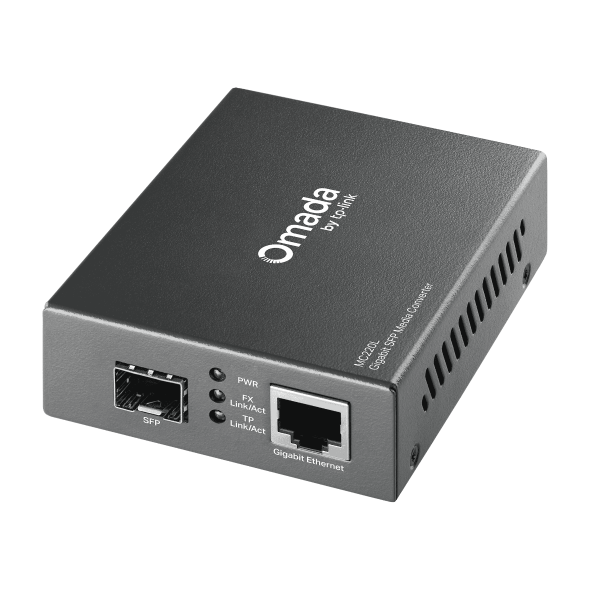
A common edge deployment pattern uses an SFP module at the switch, a fiber run to a remote location, and a media converter at the far end to drop back to copper or PoE for a camera or outdoor access point. The Omada MC220L accepts a 1G SFP module on the fiber side and provides a standard copper RJ45 port; the MC420L does the same at 10G, with auto-sensing 1G/2.5G/5G/10G copper output.
Explore the full Omada media converter lineup for deployment-specific options.
Multi-Gigabit and 10G Backbones
Wi-Fi 7 access points with 2.5G or 10G uplink ports can saturate a 1G switch uplink during peak usage. SFP+ slots on multi-gig access switches let the backbone run at 10G while client-facing ports run at 2.5G or 1G, ensuring the uplink doesn't become the constraint.
For a full overview of how SFP+ backbone links fit into multi-gig network designs, explore Omada multi-gig technology.
How to Choose the Right SFP Module
Selecting a module comes down to five variables: speed, media, connector, distance, and environment.
- Speed: Match the module to the slot. SFP slots run 1G; SFP+ slots run 10G (backward compatible with 1G); SFP28 slots run 25G (typically backward compatible with 10G and 1G). Verify the slot type on the switch before selecting a module.
- Media: Choose copper RJ45 for short runs without fiber infrastructure. Choose multimode fiber for runs up to 300–550 meters on OM3 or better. Choose single-mode fiber for anything beyond 550 meters.
- Connector and distance: Most fiber SFPs use an LC duplex connector on dual-strand fiber. BX WDM variants (SM321A/SM321B) use an LC simplex connector on a single fiber strand, halving fiber consumption on long runs. Match the module's rated distance to the fiber run: 550 m for 1000BASE-SX, 20 km for 1000BASE-LX, 300 m for 10GBASE-SR on OM3, 10 km for 10GBASE-LR.
- Environment: Standard commercial modules are rated 0–70°C and suit indoor, temperature-controlled locations. For outdoor enclosures or factory environments with temperature extremes, choose an ISM-series industrial module rated -40 to 85°C.
Third-party MSA-compliant modules are generally compatible with Omada switch slots, but any third-party module should be validated against its spec sheet before deploying at scale.
SFP in Omada Networks
Omada covers the full SFP ecosystem — from gigabit fiber to 100G aggregation — with switches, modules, cables, and media converters that work together across a centrally managed network.
- Switches with SFP, SFP+, and SFP28 slots span every tier, from access switches with GE SFP uplinks to campus-level L3 switches with 25G SFP28 and 10G SFP+ in the same unit. Browse the full Omada switch collection.
- Modules and direct attach cables covering 1G through 100G, plus industrial-hardened gigabit options. See the full Omada modules and cables catalog for all SKUs with specifications.
- Media converters (MC220L for gigabit fiber-to-copper, MC420L for 10G fiber-to-copper) bridge fiber and copper for mixed deployments. The Omada accessories hub includes a range of supporting hardware.
Choosing the Right SFP for Your Deployment
SFP is a hot-swappable interface that turns a single switch port into a copper or fiber link. Its value is the ability to match media and distance to the deployment rather than designing around fixed port types. The family scales from 1 Gbps to 100 Gbps through SFP+, SFP28, and QSFP28, using the same plug-in concept across all tiers.
The Omada modules and cables lineup lists the full catalog organized by speed and media type. For deployments that also need media converters or DACs, explore the Omada accessories hub.
Frequently Asked Questions
What does SFP stand for in networking?
SFP stands for Small Form-Factor Pluggable. It's a compact, hot-swappable transceiver standardized under an industry Multi-Source Agreement, meaning compatible modules from different manufacturers can be used in the same switch slot.
What is the difference between an SFP port and an SFP module?
The SFP port (also called an SFP slot) is a permanent interface built into the switch, router, or media converter that accepts pluggable transceivers. The SFP module is the removable transceiver that inserts into that port. The port sets the maximum supported speed; the module determines whether the link runs over fiber or copper and how far it can reach.
Is SFP faster than RJ45 Ethernet?
It depends on the module. Standard gigabit SFP and a gigabit RJ45 port run at the same 1 Gbps. The key difference is distance: a 1000BASE-LX fiber SFP reaches 20 km, while copper RJ45 tops out at 100 meters. SFP+ runs at 10 Gbps, SFP28 at 25 Gbps, and QSFP28 at 100 Gbps, well beyond what standard copper Ethernet supports over typical cable runs.
What is the difference between SFP and SFP+?
SFP and SFP+ share the same physical housing, but SFP+ operates at 10 Gbps while standard SFP operates at 1 Gbps. SFP+ slots on most switches are backward compatible with 1G SFP modules, but a standard SFP slot will not run an SFP+ module at 10 Gbps.
How far can an SFP module transmit?
Distance depends on the module type and fiber grade: 100 meters for 1000BASE-T copper, 550 meters for 1000BASE-SX multimode fiber, 20 kilometers for 1000BASE-LX single-mode fiber, 300 meters for 10GBASE-SR multimode (on OM3), and 10 kilometers for 10GBASE-LR single-mode. WDM modules like the SM321A/SM321B reach 20 km over a single fiber strand, while the SM5110LSA-10/SM5110LSB-10 provide the same single-fiber connectivity at 10 Gbps over distances of up to 10 km.
Can I mix SFP module brands in the same switch?
Generally, yes, if the modules follow the industry Multi-Source Agreement. MSA compliance means shared physical dimensions, electrical interface, and signaling standards. Any third-party module should be validated against the switch's compatibility documentation or the module's spec sheet before deploying at scale.
Is SFP the same as a fiber transceiver?
Not exactly. SFP modules can carry fiber or copper connections. Fiber variants like 1000BASE-SX and 10GBASE-LR use optical transceivers, but 1000BASE-T and 10GBASE-T SFP modules carry electrical signals over copper RJ45. The term "fiber transceiver" is often used informally to refer to a fiber SFP, but the SFP form factor itself is media-agnostic.