


Surveillance Camera Systems for Hotels: Placement Guide
Published: August 13, 2026 | Last Updated: August 13, 2026
Quick Answer
-
Cover shared spaces thoroughly and guest room interiors never. In the Philippines, NPC Circular 2024-02 also names restrooms, toilets, and similar spaces as outright prohibited, including staff facilities.
-
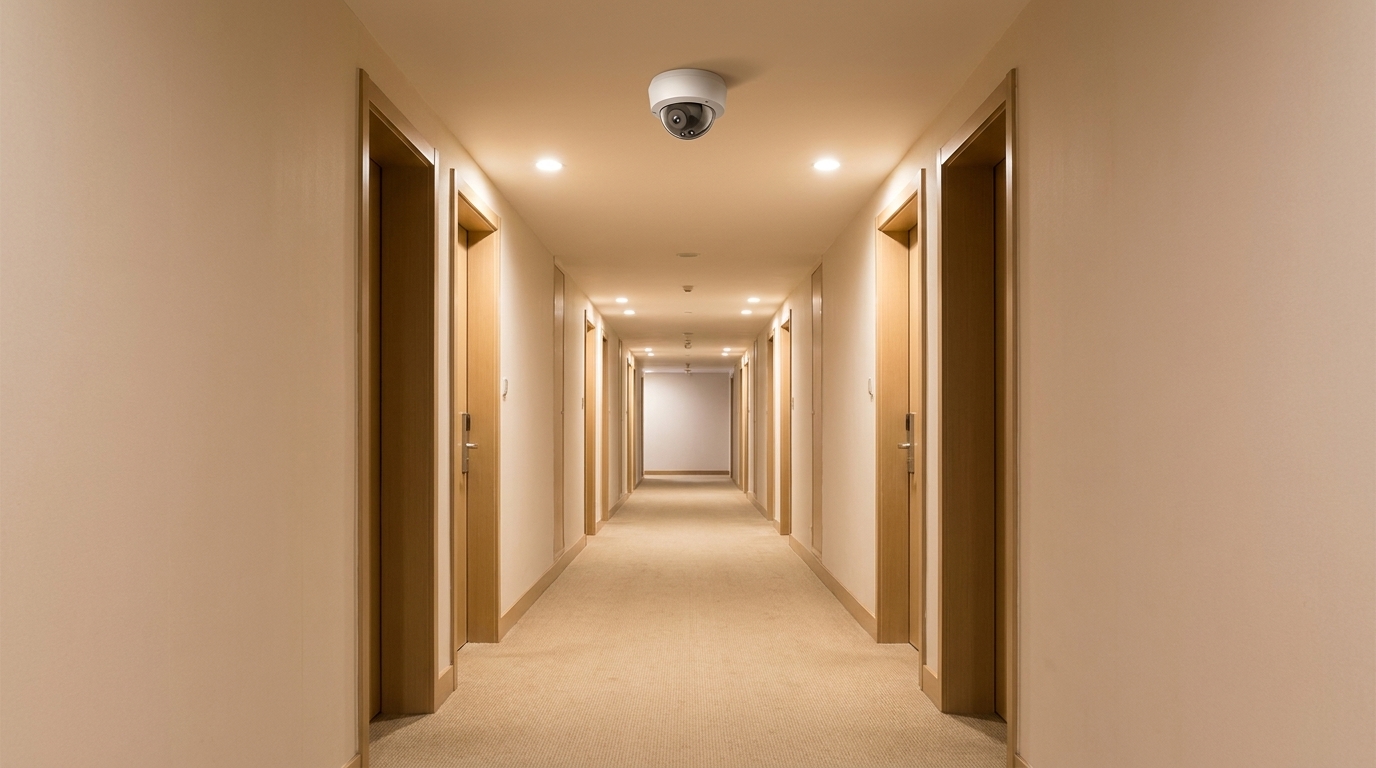
The corridor technique is to mount high at one end and angle down the full length, so the camera sees everyone in the hallway without ever pointing into a doorway.
-
Corridor mode helps, and it is a mounting decision rather than a setting: the camera is physically rotated 90 degrees. It also rules out recorder-based AI detection on that camera.
A hotel has to do two things at once that pull in opposite directions. Guests expect the property to be watched, and they expect not to be. Get the balance wrong in one direction, and you have blind spots at the places incidents actually happen. Get it wrong in the other, and you have a privacy problem that is also a legal one. The hardest place to hold both is the guest floor corridor, one door away from a private room, and the technique that resolves it is specific enough to specify to an installer.
Table of Contents
Where Do Hotel Cameras Belong?
How Do You Cover a Guest Corridor Correctly?
What Is Corridor Mode, and What Does It Cost You?
How Should the Lobby Be Covered?
What About Back-of-House and Staff Areas?
What Does Philippine Law Require of a Hotel?
What Do Hotels Most Often Get Wrong?
Where Do Hotel Cameras Belong?
In shared and public areas, and nowhere else. That sounds obvious until you map a property and find how many spaces sit in between.
The clear yes list is short: lobbies and the front desk, guest floor corridors, elevators and elevator lobbies, stairwells, entrances and exits, parking and exterior approaches, and back-of-house corridors and storage.
The clear no list is shorter, and it is absolute. Guest room interiors, obviously. But in the Philippines, the prohibition is broader than most hotel operators realize, and it is written down. NPC Circular 2024-02 prohibits CCTV in areas where people have a heightened expectation of privacy, naming restrooms, toilets, fitting rooms, and lactation or breastfeeding rooms. A hotel has all four, in public areas and in staff areas both, and the staff side is where a well-meaning installer covering back-of-house is most likely to cross the line.
Feature-to-Benefit: Coverage by Hotel Zone
|
Zone |
Priority |
The placement point |
|
Guest floor corridors |
High |
Mount at one end, angled down the length, never facing a single door |
|
Lobby and front desk |
High |
Several angles, covering the desk, the floor, and the entrance separately |
|
Elevators and elevator lobbies |
High |
Records floor access, which corridors alone cannot |
|
Entrances, exits, stairwells |
High |
The points everyone must pass through, including those avoiding the lobby |
|
Parking and exterior |
High |
Watch for guest room windows and balconies falling in frame |
|
Back-of-house corridors and storage |
Medium |
Valuable stock, low oversight |
|
Guest room interiors |
Never |
Private space |
|
Restrooms, toilets, staff changing areas |
Never |
Prohibited by name under NPC Circular 2024-02 |
The shared circulation spaces where everyone passes are the priority, because they are what connect the property together and what an investigation would actually need. Parking and exterior coverage matter but carries its own privacy question, since a camera covering a car park can easily take in guest room windows above it. And the never list is not a judgment call; it is a rule with named spaces.
What it means for you: walk the property with a floor plan and mark three categories, not two: cover, do not cover, and prohibited. The third one is where hotels get into trouble, because it includes staff spaces nobody thought of as sensitive.
How Do You Cover a Guest Corridor Correctly?
Mount the camera high at one end of the corridor and angle it down the full length toward the far end. That single decision is the difference between a compliant system and a liability.
The failure it prevents is specific. A camera mounted near a particular door and aimed at that door will see into the room every time it opens. That is a recording of a private space, and no amount of good intent changes what is on the footage.
The technique avoids it by geometry rather than by policy. From one end of a hallway, a camera sees the people walking it: their faces as they approach or leave, what they are carrying, which direction they went, and when. It records doorways only in profile, as part of a wall, and never through one.
Three details make it work in practice. Mount high, above head height, so a person nearer the camera does not block the corridor behind them. Cover long corridors from both ends where budget allows, since a single camera captures faces from only one direction. And check what is in frame at the far end, because a corridor that terminates in a window or an open lounge puts something else in the shot.
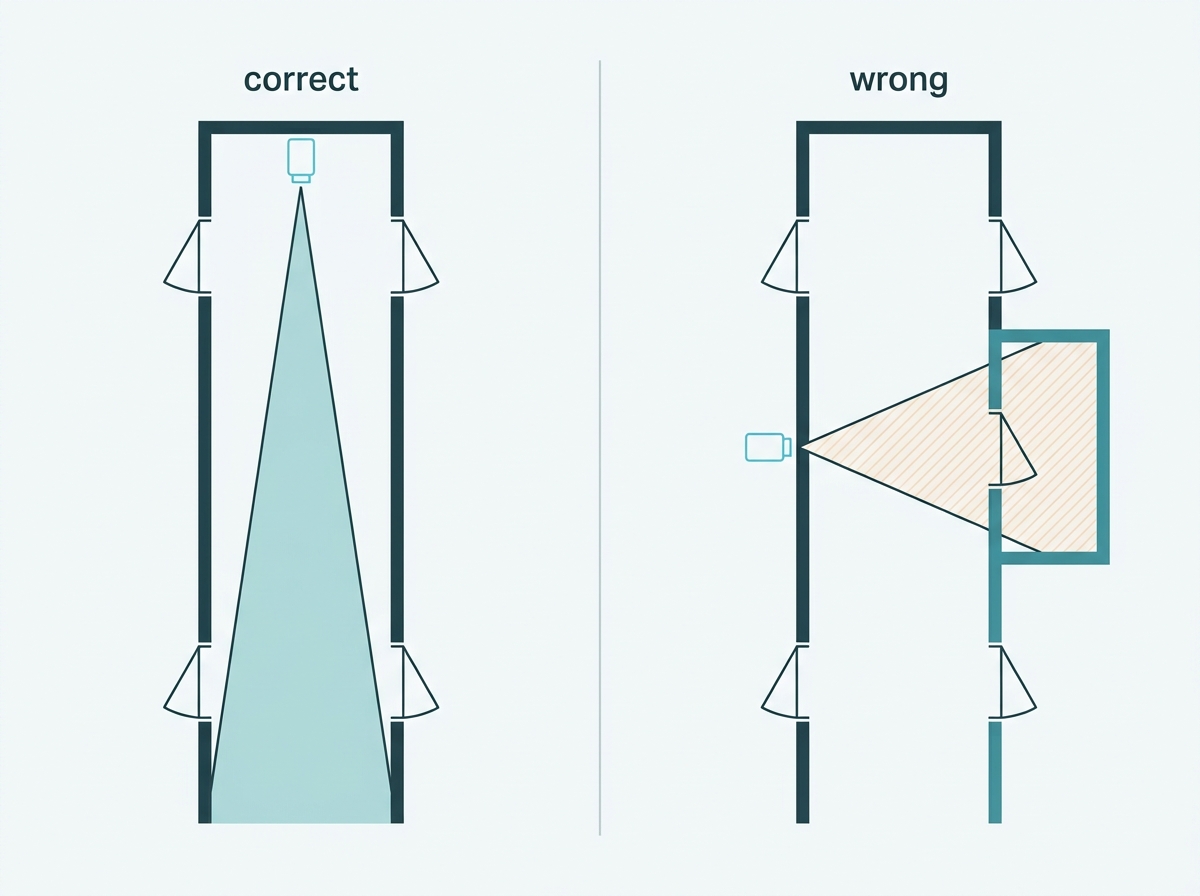
What it means for you: specify the mounting position to your installer rather than leaving it to them. "One camera at each end of the corridor, angled along its length, none facing a door" is a sentence that prevents the problem entirely.
What Is Corridor Mode, and What Does It Cost You?
It rotates the image 90 degrees so a widescreen camera produces a tall, narrow picture instead of a wide one. In a hallway, that is a much better fit, and it comes with two conditions worth knowing before you specify it.
A standard camera image is landscape, wider than it is tall. Pointed down a corridor, most of that width is wall. Corridor mode changes the aspect ratio from 16:9 to 9:16, so the frame becomes tall and narrow like the space itself, and far more of the picture is corridor rather than plasterboard. The field of view does not get bigger. It gets reshaped, trading horizontal coverage you do not need for vertical coverage you do.
Condition one: it is a mounting decision, not a setting. The camera has to be physically rotated 90 degrees when it is installed, and then the image rotated in the camera or recorder settings to bring it upright. Deciding to use corridor mode after the cameras are mounted means going back up the ladder.
Condition two, and this is the one nobody mentions. TP-Link states that its AI by NVR feature is not recommended when corridor mode is enabled. AI by NVR is the arrangement where the recorder runs the detection algorithms rather than the camera, which is how cameras without their own AI get classification. So a hotel planning corridor mode on guest floors and recorder-based detection across the property has to choose. If you want human and vehicle classification on corridor cameras, the classification needs to run on the cameras themselves.
That is not an argument against corridor mode. It is an argument for deciding both questions at the same time, because they are the same decision.
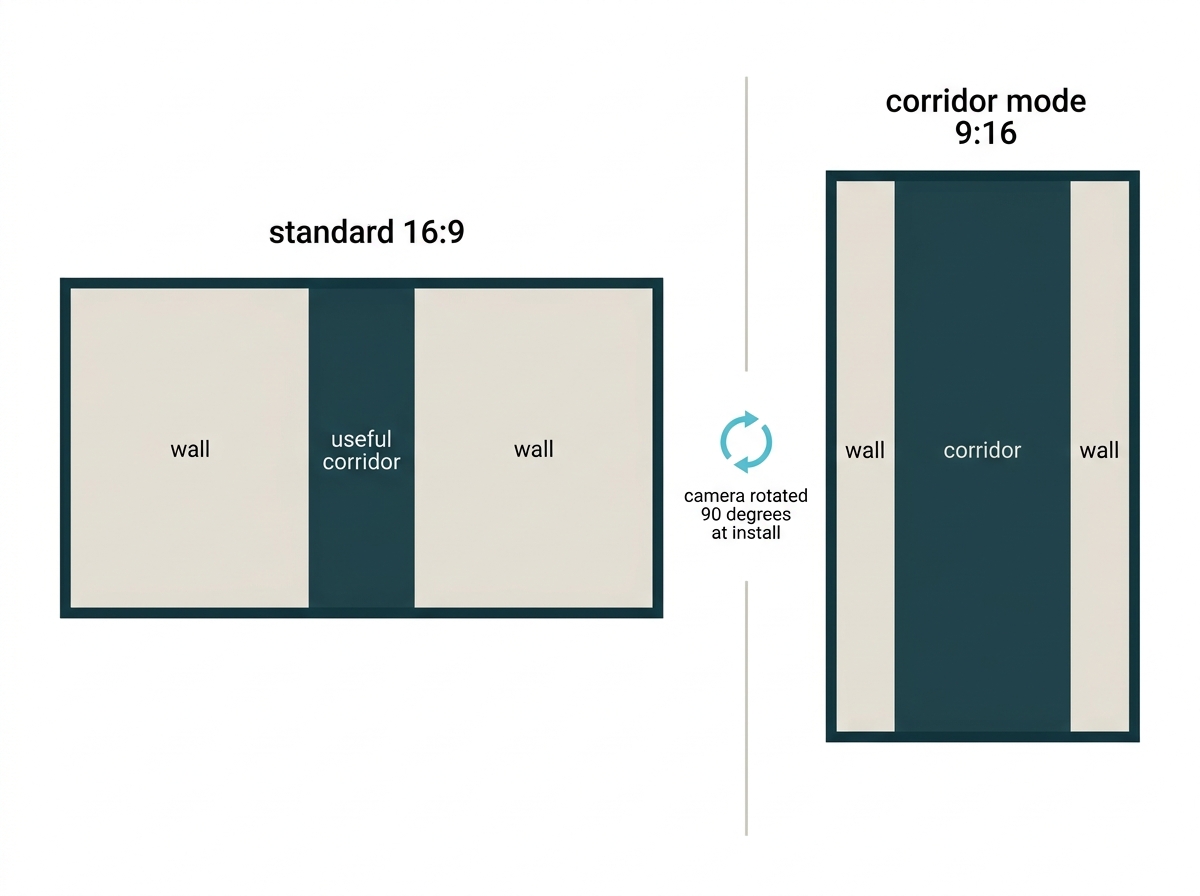
What it means for you: decide corridor mode before installation day, and decide at the same time where detection will run. Both are cheap now, and both mean re-mounting cameras later.
How Should the Lobby Be Covered?
With several cameras doing different jobs rather than one trying to do all of them. The lobby carries more traffic than anywhere else in a hotel, and it is where footage is most often needed afterwards.
Three distinct views are worth having. The front desk, covering the interaction itself, which matters for disputes as much as for security. The lobby floor, covering movement, seating areas, and where people wait. The entrance, capturing everyone arriving before they reach the desk, which is the view that identifies someone who never checked in.
A pan-tilt camera suits a large lobby, since one unit can patrol several positions or be directed manually during an incident. With one condition specific to hotels. NPC Circular 2024-02 requires that pan, tilt, and zoom functions must not result in surveillance of private spaces. A lobby camera that can rotate can potentially face a corridor, a lift lobby leading to guest rooms, or a window. VIGI cameras support a PTZ limit that bounds how far the camera can travel in each direction, so it physically cannot reach a position you have excluded, and TP-Link documents this specifically as a privacy measure for cameras near private areas.
Set those limits during installation, walking the boundary of what the camera is permitted to see, in the same visit that sets its patrol route.
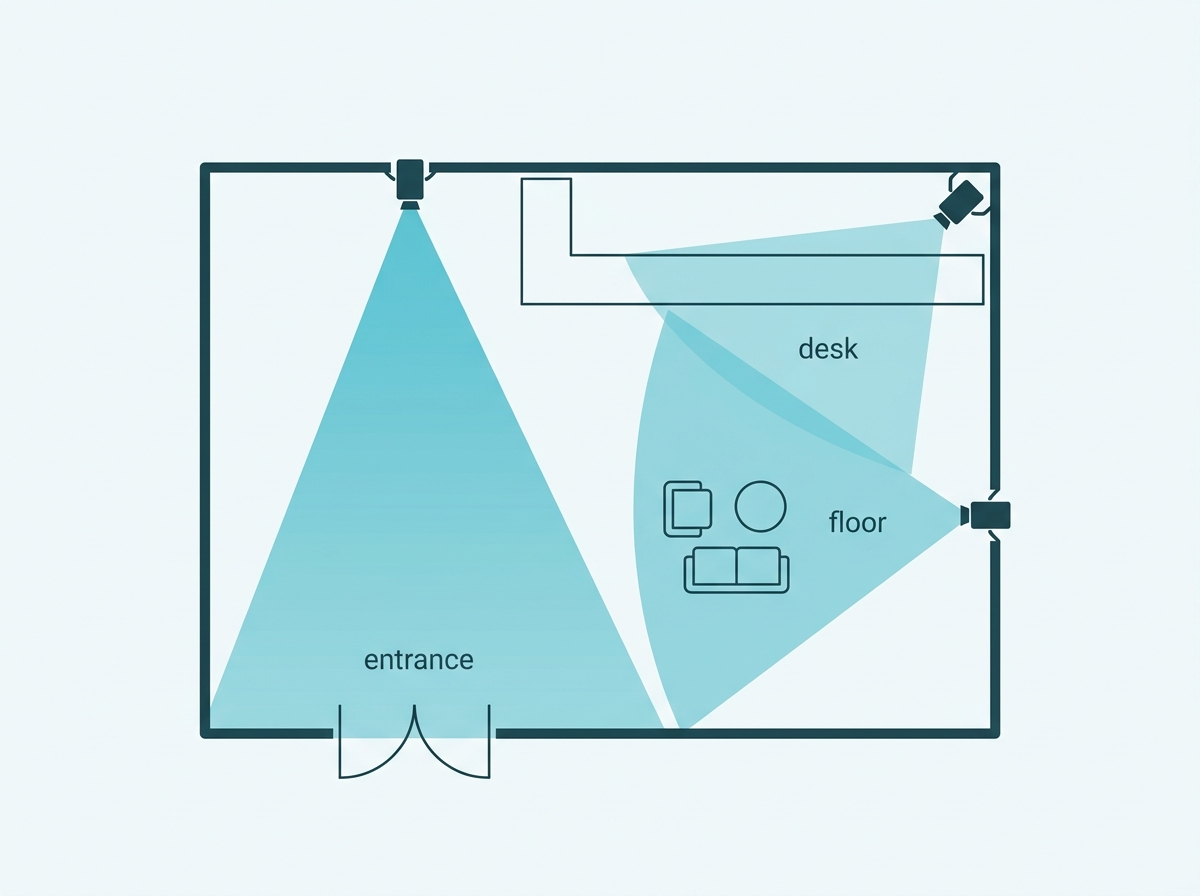
What it means for you: if you put a moving camera in the lobby, bound its travel the same day it goes up. A camera that can be pointed somewhere it should not go eventually will be.
What About Back-of-House and Staff Areas?
Cover the corridors and the storage, and stay out of the staff facilities. This is the zone where the prohibited-space rule applies to most hotels, and it is easy to get wrong with good intentions.
Storage rooms, linen stores, stock areas, and service corridors carry real value and see little oversight precisely because they are away from guests. They do not need the camera density of a lobby, but leaving them uncovered creates a blind spot exactly where internal loss is hardest to detect otherwise.
What does not get a camera: staff toilets, changing areas, and any lactation or rest facilities. These are named in the Circular's prohibited list, and there is no operational argument that overrides it. A camera covering the corridor outside a staff changing room is fine, and it should be positioned so the doorway is in profile rather than facing into it, which is the same technique the guest corridor section describes.
What it means for you: treat staff privacy with the same seriousness as guest privacy. The rule does not distinguish, and staff are the people most likely to notice and least likely to have been consulted.
What Does Philippine Law Require of a Hotel?
More specifically than "post a sign." NPC Circular 2024-02 governs CCTV use, and a hotel is comprehensively within its scope, since it defines a semi-public space as privately owned space open to the public during operating hours.
Visible notice that cameras are operating, posted where guests will see it, at entrances and prominent locations.
A declared purpose, with coverage proportionate to it. "Because we can see that area" is not a purpose.
Prohibited spaces respected: restrooms, toilets, fitting rooms, lactation rooms.
Movement limits on any camera that can pan, tilt, or zoom, so those functions cannot surveil private spaces.
A documented retention period, set by what the purpose needs, with footage destroyed afterwards, and specifically not determined by how much storage the recorder happens to hold.
Restricted and logged access, limited to named authorized personnel, with records of viewing, copying, and transfers.
A response capability. When someone requests footage of themselves, a hotel has five working days to arrange a viewing and fifteen working days to provide a copy, extendable once. That is worth testing before it is needed rather than after.
The full set of obligations, including which of them change what equipment you buy, is covered in CCTV System Philippines Buyer's Guide, and how surveillance fits a business operation more broadly is covered in Surveillance Solutions for Philippine Businesses.
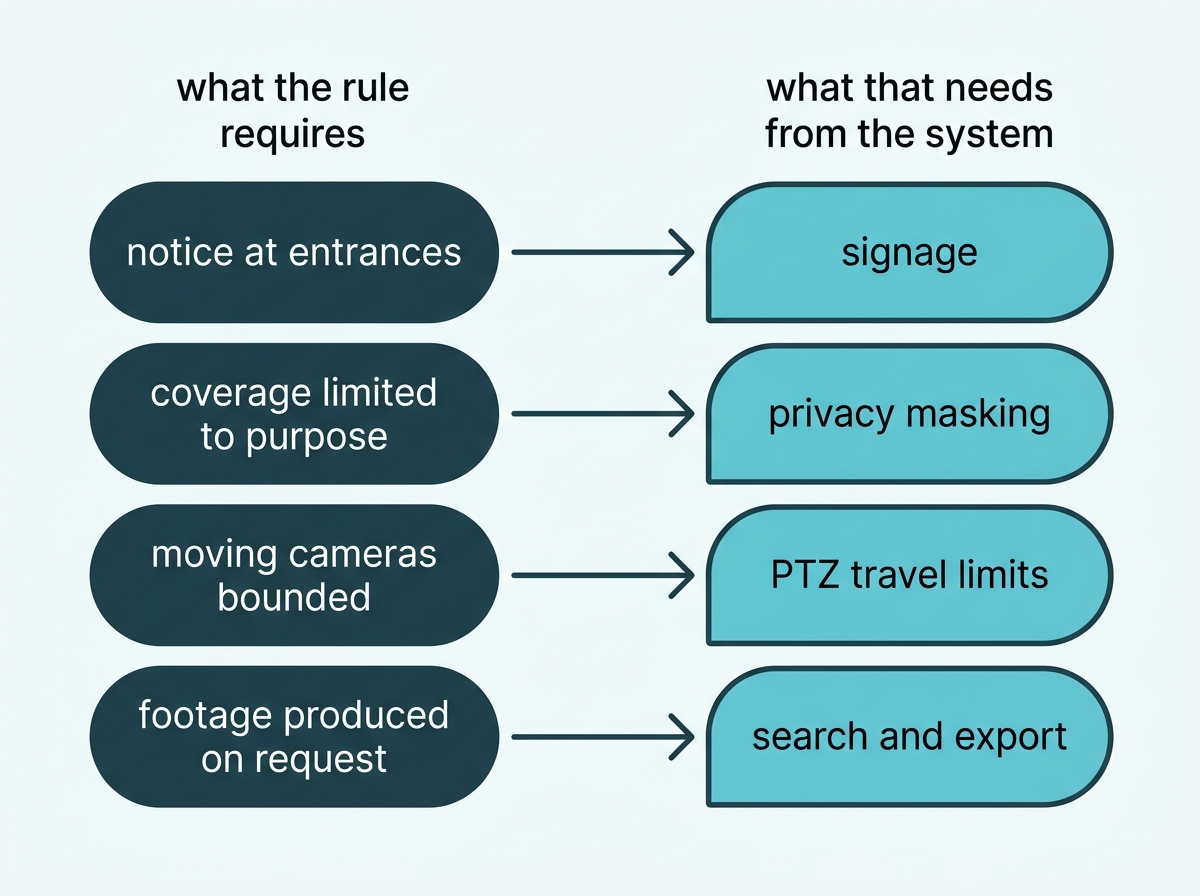
What it means for you: decide your purpose and retention period in writing before you order anything. They are the two answers everything else hangs from, and the two you would be asked for first.
What Do Hotels Most Often Get Wrong?
Four things, and none of them is buying the wrong camera.
Aiming a corridor camera at a door. Covered above, and the most consequential.
Forgetting windows and balconies. An exterior or car park camera on a property with a courtyard can easily take in guest room windows on the floors above. Nobody intends it, and it is visible in the footage. Check the vertical extent of every exterior camera's view, not just the horizontal.
Treating staff areas as exempt. They are not, and the prohibited list applies to back-of-house as much as to public spaces.
Leaving a moving camera unbounded. A pan-tilt camera without travel limits will eventually be pointed somewhere it should not go, by an operator or by a patrol route nobody reviewed.
To compare cameras and recorders for a hospitality deployment, browse VIGI cameras and VIGI network video recorders, see how VIGI groups its offering under solutions by industry, or explore VIGI's hospitality surveillance solutions.
What it means for you: walk the property once with the finished system and look at what each camera actually sees, not what the plan said it would. Three of these four are visible in thirty seconds on a monitor.
Frequently Asked Questions
Can a hotel install cameras inside guest rooms?
No. A guest room is a private space, and recording inside one is a serious privacy violation regardless of intent. In the Philippines, NPC Circular 2024-02 also prohibits cameras outright in restrooms, toilets, fitting rooms, and lactation or breastfeeding rooms, which applies to staff facilities as much as guest ones.
How should cameras be positioned in guest floor corridors?
Mounted high at one end of the corridor and angled down its full length, rather than close to a door and aimed at it. From one end, the camera captures faces, direction, and timing for anyone in the hallway while seeing doorways only in profile, so it never records into a room when a door opens.
What is Corridor Mode on a security camera?
It rotates the image 90 degrees, changing the aspect ratio from a wide 16:9 to a tall 9:16 that matches the shape of a hallway, so less of the frame is wall and more is corridor. It reshapes the field of view rather than enlarging it, and it requires the camera to be physically rotated at installation and the image corrected in settings.
Does corridor mode affect anything else on the system?
Yes, and it is worth planning around. TP-Link states that its AI by NVR feature, where the recorder runs detection for cameras that lack their own, is not recommended when corridor mode is enabled. If you want classification on corridor cameras, it needs to run on the cameras rather than on the recorder.
Does a hotel in the Philippines need signage about CCTV?
Yes. NPC Circular 2024-02 requires visible notice that a CCTV system is in operation, posted where people can see it, and a hotel is within scope because its public areas meet the Circular's definition of a semi-public space. Notice is also what makes the system function as an open safety measure rather than a covert one.
Can PTZ cameras be used in a hotel lobby?
Yes, and they suit a large lobby, since one camera can patrol several positions or be directed manually during an incident. The condition is that the Circular requires pan, tilt, and zoom functions not to surveil private spaces, so set the camera's travel limits at installation to bound where it can physically point.
How quickly does a hotel have to provide footage if a guest requests it?
Five working days to arrange a viewing and fifteen working days to supply a copy, with one extension of up to fifteen further days possible, under NPC Circular 2024-02. Meeting that means being able to find footage by date, time, and camera and export it intact, which is worth testing before a request arrives.
Final Thoughts
Hotel surveillance is the same equipment as any business system, arranged with far more care. What makes it different is that the property contains private space and shared space one door apart, and the boundary between them runs through the middle of the area you most need to cover.
The corridor is where that gets decided. Mount high at one end, angle down the length, never face a door. If you use corridor mode to fit the frame to the space, treat it as a mounting decision and settle where detection will run at the same time, because the two are linked and both are expensive to change afterwards.
The rest follows from a floor plan with three categories on it rather than two. Cover, do not cover, and prohibited. The third category is the one that catches properties out, because it includes staff toilets and changing areas that nobody thought of as a privacy question until someone raised it.
If you want the plan checked before you commit, bring a VIGI specialist three things: a floor plan of the public areas and guest floors, a note of which exterior positions can see guest room windows, and the number of days of footage you have decided to keep. You will get back a camera layout that covers the circulation spaces without pointing anywhere it should not, the positions where corridor mode is worth the mounting work, and a storage figure sized to your retention rather than to a bundle. Or explore VIGI's hospitality surveillance solutions to see the cameras and recorders behind the layout above.