


Network Segmentation Explained: Benefits, Best Practices, and Common Mistakes
Published: August 4, 2026 | Last Updated: August 4, 2026
Quick Answer
-
Segmentation contains breaches by forcing traffic between zones through a firewall, router, or access control list, so a compromise in one zone does not automatically reach another.
-
Most small and mid-sized businesses implement it with VLANs plus firewall rules. Micro-segmentation, which applies policy per workload, is a data center and zero-trust tool that most SMBs do not need.
-
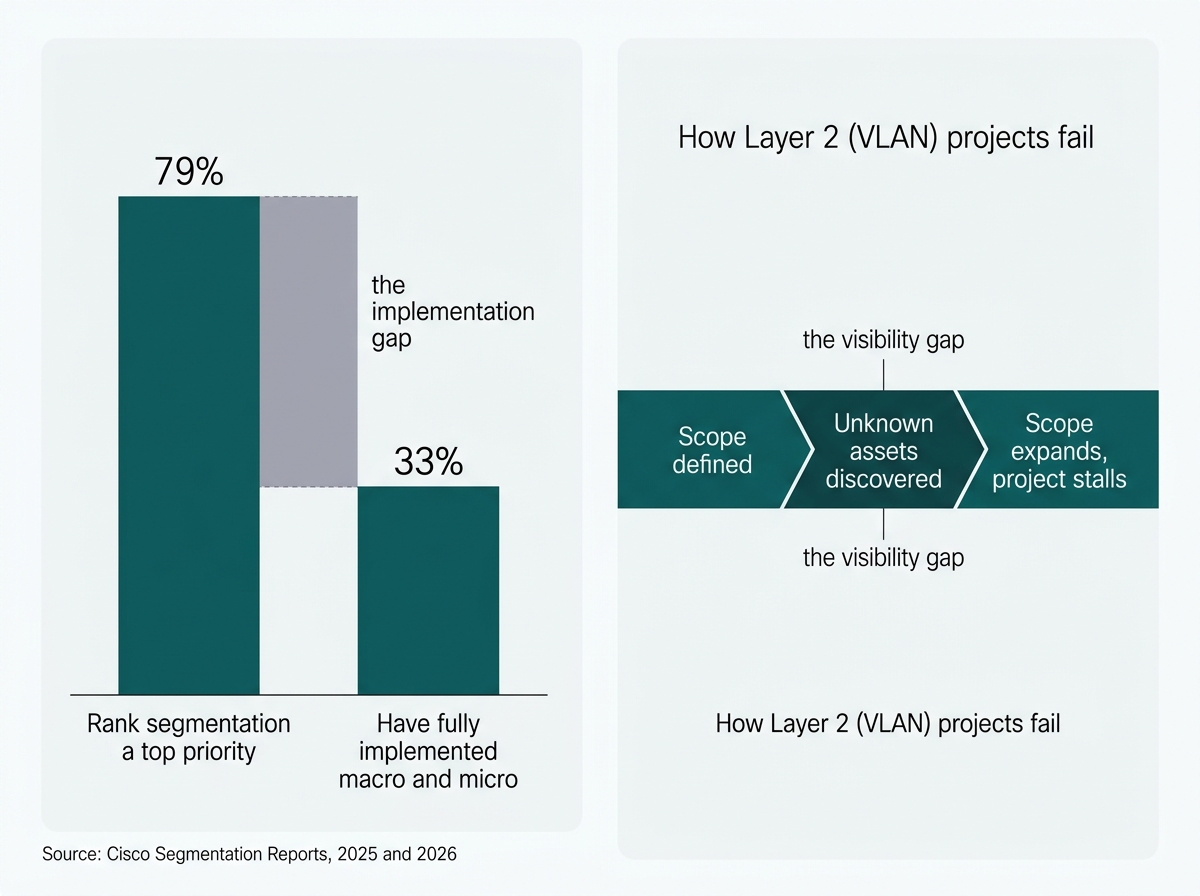
The common failure is scope, not disagreement. Layer 2 projects, meaning VLAN-based ones, most often stall when assets are discovered mid-project, which is why NIST's zero trust guidance puts asset inventory before any policy decision, not after.
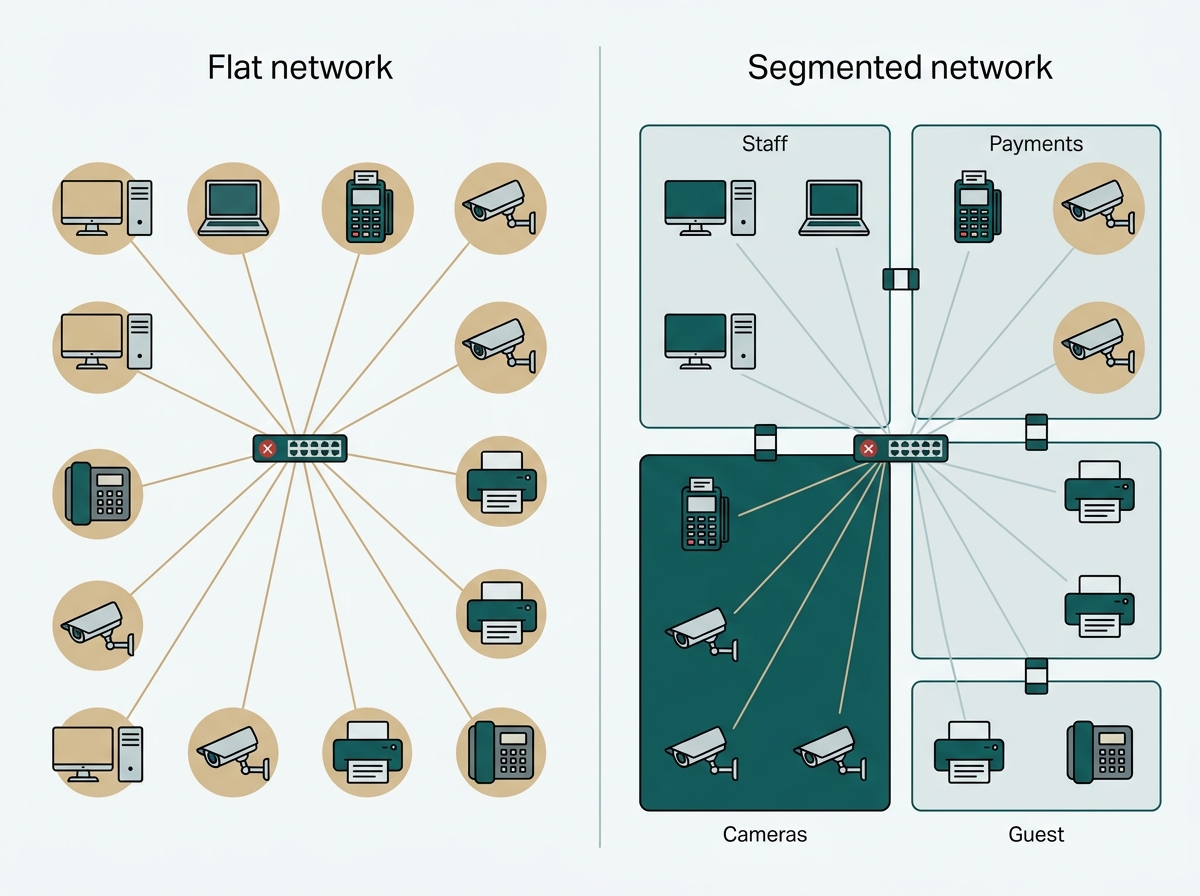
Network segmentation is the practice of dividing one network into smaller isolated zones, so traffic between them is controlled, filtered, or blocked by policy rather than flowing freely. Its main purpose is containment. On a flat network, one compromised device can reach everything. On a segmented network, an attacker has to cross an enforcement point to move anywhere else. Most businesses accept the case for it. Far fewer finish doing it, and the reason is now well documented.
Table of Contents
How Does Segmentation Limit a Breach?
What Are the Main Segmentation Methods?
How Do You Implement Segmentation?
Why Do So Many Segmentation Projects Stall?
Does Segmentation Affect Network Performance?
What Is Network Segmentation?
Network segmentation is the practice of dividing a computer network into smaller isolated sections, so that traffic between those sections is controlled, filtered, or blocked according to a defined policy.
Each segment functions as its own contained zone. Devices inside a segment communicate freely with each other, but anything crossing into another segment has to pass an enforcement point, typically a firewall, router, or access control list. That is what separates a segmented network from a merely large one. A flat network lets any device potentially reach any other. A segmented network restricts that by design.
Most business networks start flat. The front-desk computer, the security camera, and the guest's phone all sit on the same network with the same reach. That works until something goes wrong.
Segmentation is one layer of a broader design, and our network infrastructure and design guide covers the order these decisions should be made in.
What it means for you: if you have never deliberately separated anything, you have a flat network. That is a design decision made by default rather than chosen.
How Does Segmentation Limit a Breach?
Segmentation limits a breach by removing the attacker's free movement. On a flat network, compromising one device gives an attacker a path to every other device on it. On a segmented network, that compromise reaches one zone, and going further means finding and crossing an enforcement point, which takes time and is far more likely to be detected.
This containment is why segmentation appears throughout compliance frameworks. Under PCI DSS, segmentation is not mandatory in itself, but it determines how much of your network falls within the scope of an assessment. Isolating payment systems means the assessment covers the cardholder data environment rather than everything you own, which is usually the difference between a manageable audit and an expensive one.
What it means for you: the question is not whether you can be breached. It is how much of your business one breached device can reach.
What Are the Main Segmentation Methods?
|
Method |
How it works |
Typical use |
What it costs you |
|
VLANs |
Logical grouping at the switch level, independent of physical location |
Separating departments, guest Wi-Fi, and cameras on one physical network |
Requires managed or smart switches, and careful port assignment |
|
Subnetting |
Dividing IP address ranges into distinct blocks |
Layer 3 addressing paired with VLANs for routing between segments |
Address planning that is awkward to change later |
|
Firewalls and ACLs |
Rule-based filtering between segments |
Enforcing which segments may communicate, and how |
Rules that need auditing as the network changes |
|
Micro-segmentation |
Policy applied down to the individual workload or device |
Data centers, zero-trust architectures, and high-security environments |
Substantial tooling and ongoing policy maintenance |
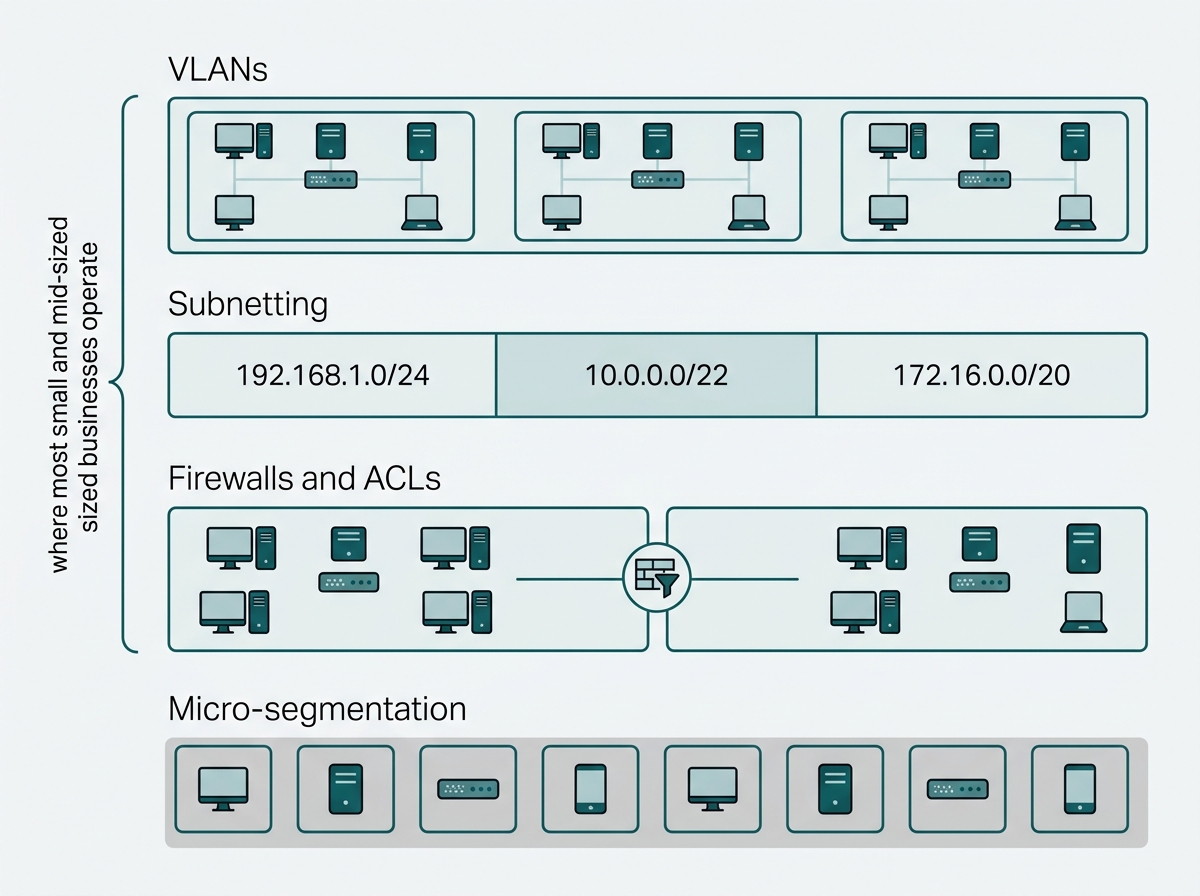
VLANs group devices logically at the switch regardless of where they sit physically, which is how most businesses separate guest Wi-Fi, staff devices, and cameras on one set of cabling. Subnetting divides IP ranges and pairs with VLANs so traffic can be routed between segments. Firewalls and access control lists are what actually enforce which segments may talk to each other. Micro-segmentation pushes policy down to individual workloads and belongs in data centers and zero-trust environments.
Most small and mid-sized businesses implement segmentation through VLANs paired with firewall rules, which covers the practical need without the overhead of full micro-segmentation. VLANs require a managed or smart switch, which is worth confirming before planning, and our guide to managed and unmanaged switches covers where that line falls.
What it means for you: VLANs plus firewall rules are the answer for most businesses. If a vendor proposes micro-segmentation for a twenty-person office, ask what problem it solves that a VLAN does not.
How Do You Implement Segmentation?
Segmentation is a sequence, not a single configuration step, and the order matters more than most plans assume.
Start with an asset inventory, not a VLAN plan. Before designing zones, establish what is actually on the network. This is the step most often skipped, and as the next section explains, skipping it is the most common reason projects stall.
Then decide what genuinely needs isolating. Guest Wi-Fi from staff devices. Point-of-sale systems from general office traffic. Security cameras from machines handling sensitive data. Segmenting into as many pieces as technically possible is not the goal. Segmenting along the lines that matter for security and performance is.
Assign VLANs and define what may cross. VLANs create the logical separation, and firewall rules or access control lists define exactly what traffic, if any, may pass between segments. Default to full isolation and make every path between segments a deliberate exception.
Test rather than assume. A segment that looks correctly configured can still have gaps: an overly broad firewall rule, a port left on the wrong VLAN. Verify that a device in one segment genuinely cannot reach a segment it should not, and re-verify as the network changes. That is part of segmentation, not an optional follow-up.
For the VLAN mechanics that underpin most segmentation, see VLAN configuration explained, and for a specific application of segmentation to a common device type, see the CCTV network design guide. To see the controller platform segmentation is configured through, explore Omada SDN controllers.
What it means for you: if you cannot list every device on your network today, that is step one, and it is not a formality.
Why Do So Many Segmentation Projects Stall?
Because the scope grows during the project, not because anyone disagrees it is worth doing.
Most businesses accept the case for segmentation before they start. Far fewer finish, and the pattern behind that gap traces back to one decision: whether the team knew what was actually on the network before it started assigning VLANs. A project that begins with a defined scope but no real asset inventory tends to grow as new devices, subnets, and dependencies surface mid-build, and each discovery pushes the finish line further out.
This is not a guess about project management. It is the reasoning built into NIST's zero trust guidance (SP 800-207), which treats knowing what assets exist, and continuously verifying their state, as a precondition for any segmentation or access decision, not a step that can be backfilled once policy is already in place. NIST's Cybersecurity Framework similarly lists asset management as a foundational function that has to be in place before protective controls like segmentation can be applied effectively.
The practical takeaway is the same regardless of company size: a VLAN plan built on an incomplete picture of the network will keep changing shape until someone stops to count what is actually connected.
What it means for you: the way to finish is to make the project smaller. Pick the two or three zones that matter most, inventory what belongs in them, complete those, then start again. One large all-at-once effort is the shape that stalls.
Does Segmentation Affect Network Performance?
Usually it helps, though the honest answer depends on where your traffic goes.
Keeping high-bandwidth or unrelated traffic in separate segments reduces congestion, so a segment carrying video conferencing does not compete with general browsing. Segmentation also makes monitoring tractable, since reviewing logs for one well-defined segment is a far smaller job than making sense of everything mixed together.
The cost is that traffic crossing between segments has to pass an enforcement point, which adds a hop and some processing. For most businesses, the great majority of traffic stays inside its own segment, so the congestion benefit comfortably outweighs the crossing cost. If your design forces constant traffic between segments, that is usually a sign the zones were drawn in the wrong places.
What it means for you: draw zones so that most conversations happen inside one. If a segment cannot function without constantly reaching another, the two probably belong together.
Frequently Asked Questions
What is the difference between network segmentation and a VLAN?
A VLAN is one technical method used to implement segmentation. Segmentation is the broader security and architecture practice, and VLANs, subnetting, firewalls, and micro-segmentation are all tools used to achieve it.
Why is network segmentation important for small businesses?
It keeps a breach or malware infection contained to one part of the network instead of letting it spread everywhere. It also reduces compliance scope, since isolating payment systems means a PCI DSS assessment covers the cardholder data environment rather than your whole network.
What is micro-segmentation, and do I need it?
Micro-segmentation applies policy at the individual workload or device level rather than the zone level. It is common in data centers and zero-trust environments, and most small and mid-sized businesses get adequate protection from VLAN-based segmentation without it.
How many segments should a business network have?
There is no fixed number. Identify which traffic types genuinely need isolation, typically guest Wi-Fi, staff devices, payment systems, and security cameras, and build segments around those distinctions rather than segmenting for its own sake.
What should I do before assigning VLANs?
Build an asset inventory. Layer 2 segmentation projects most often stall when scope expands after assets are discovered mid-project, which traces back to starting without adequate visibility into what was on the network in the first place. NIST's zero trust guidance treats this kind of asset visibility as a precondition for policy decisions, not a step that can be added later.
Does network segmentation slow down the network?
Usually the opposite. Separating unrelated traffic types reduces congestion, though traffic crossing between segments does pass an enforcement point and takes an extra hop. Since most traffic stays within its own segment in a well-designed network, the net effect is normally a performance gain.
Why do so many organizations struggle to fully implement segmentation?
Segmentation touches every part of a network at once, and scope tends to grow during the project when the team did not start with a clear inventory of what needed to be segmented. The response to a stalled project often focuses on process fixes, such as better coordination and clearer timelines, when the actual gap was technical: nobody had a complete picture of the network before the VLAN plan was drawn up.
Final Thoughts
Network segmentation is not a configuration step. It is the ongoing practice of deciding which traffic genuinely needs isolating and enforcing that boundary deliberately, rather than leaving everything reachable because nobody chose otherwise.
The businesses that finish are the ones that start small: guest access, payment systems, cameras, in that order, with an asset inventory before each. Projects stall when scope grows mid-flight because nobody knew what was on the network to begin with, and no amount of better coordination fixes a visibility problem.
If you are planning segmentation and want the zones drawn the first time properly, start with the list. Write down every device that connects, group them by what they actually need to reach, and bring that to an Omada specialist along with your current switch models. You will get back a VLAN plan scoped to your zones, the firewall rules that enforce them, and a flag on any switch that cannot support what the plan needs. Explore Omada SDN controllers to see where the VLAN and access policies are configured and pushed across every site at once, which is what keeps a segmentation plan from quietly reverting device by device.