


What Is Network Segmentation? Types, Benefits, and Best Practices
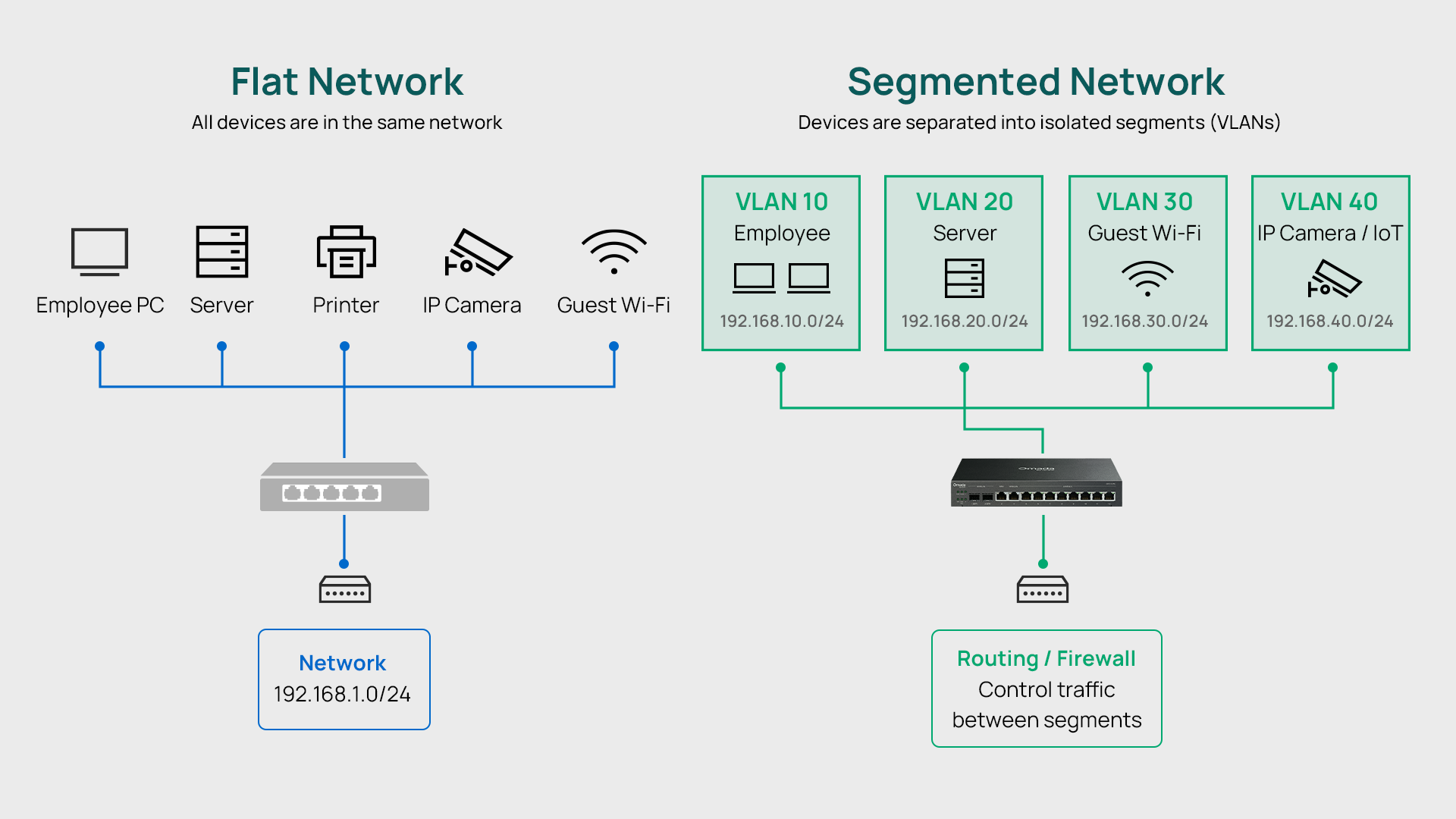
Picture a flat network where a guest's laptop, a POS terminal, and an IP camera all share the same broadcast domain: just one compromised device can reach every other device without restriction. Network segmentation is the practice of dividing a single physical network into multiple isolated logical zones, with controlled access between them.
Knowing the main segmentation methods, practical benefits, and deployment considerations helps businesses build stronger networks.

Key Takeaways
-
Network segmentation divides a network into isolated zones so that devices and users in one segment cannot freely communicate with those in another.
-
VLANs (Virtual Local Area Networks) are the most common network segmentation method, using 802.1Q tagging on managed switches to logically separate traffic without requiring separate physical networks.
-
Segmentation limits the blast radius of a security incident so a compromised device on the guest network cannot reach file servers, POS systems, or sensitive internal resources.
-
Businesses subject to the Payment Card Industry Data Security Standard (PCI DSS) and the Health Insurance Portability and Accountability Act (HIPAA) use network segmentation to isolate payment systems and environments handling electronic protected health information.
-
Omada's managed switches and SDN controller enable VLAN-based segmentation with centralized policy management across single-site and multi-site deployments.
What Is Network Segmentation?
Network segmentation is the division of a physical network into multiple logical segments — subnetworks or VLANs — with access controls governing which segments can communicate with each other. This is different from a flat network, where all connected devices share a single broadcast domain and can reach each other by default. On a segmented network, traffic between zones is only permitted when there is an explicit rule allowing it.
That inter-segment access control is enforced through ACLs (Access Control Lists), firewall rules, or gateway routing policies. Without an explicit permission in place, a device in one segment cannot initiate a connection to a device in another, even if they're connected to the same physical switches.
A flat network treats every connected device as equally trusted. That assumption is the root cause of most lateral-movement attacks and a compliance problem for any business that handles payment card data or protected health information.
Types of Network Segmentation
Network segmentation can be implemented in several ways, each using a different layer of the network stack to enforce boundaries. Understanding the differences helps in choosing the right approach or combination for your business.
VLAN Segmentation
VLANs (Virtual Local Area Networks) are the most widely used method for network segmentation in business environments. A VLAN uses 802.1Q tagging on managed switches to logically separate traffic into distinct broadcast domains without requiring separate physical switches for each network. Devices on different VLANs cannot communicate by default, regardless of which physical ports they connect to.
To separate guest Wi-Fi from internal employee traffic, isolate POS systems from general office access, or keep IoT devices like IP cameras away from file servers, VLANs are a practical choice.
For a step-by-step setup walkthrough, see the Omada VLAN configuration guide.
Subnet-Based Segmentation
Subnet-based segmentation divides the network at Layer 3 by assigning different IP address ranges to different groups of devices. A subnet by itself doesn't enforce isolation, though: routing rules and firewall policies applied at the gateway determine whether traffic between subnets is permitted.
Subnets and VLANs are often used together. The VLAN handles Layer 2 separation, and each VLAN is assigned its own IP subnet so that routing and ACL policies can be applied based on IP address ranges.
Firewall-Based Segmentation
Firewall-based segmentation enforces boundaries between network segments using stateful inspection and rule-based policies. Rather than separating segments at the switch level, a firewall sits between segments and evaluates each connection attempt against a defined rule set.
This approach provides deeper traffic control than VLAN segmentation alone, and is commonly used to enforce policies between high-trust internal zones (such as servers) and lower-trust zones (such as guest networks or IoT devices). In most deployments, firewall-based segmentation complements VLAN separation rather than replacing it.
SDN-Based Segmentation
Software-defined networking (SDN) centralizes network control in a software layer, enabling segmentation policies to be defined and applied from a single management interface rather than configured device by device. Policy changes propagate automatically across all managed switches, gateways, and access points without requiring manual per-device configuration.
For multi-site deployments, this approach significantly reduces the overhead of maintaining consistent segmentation policies across locations.
See how Omada SDN handles BYOD segmentation as an example of centralized policy enforcement.
Benefits of Network Segmentation
Segmenting a network delivers measurable improvements in security, compliance posture, and day-to-day performance. The benefits are interconnected: better containment supports compliance, and cleaner traffic separation supports performance, but each area has distinct operational implications.
Breach Containment and Lateral Movement Prevention
When a device is compromised on a segmented network, the damage is bounded by the access controls between segments. An attacker who gains control of a guest network device cannot pivot to internal servers, POS terminals, or surveillance systems if proper segmentation is in place. Without segmentation, lateral movement across a flat network is simple.
This containment model doesn't prevent breaches, but it limits their scope. A compromised IoT device on an isolated segment is a contained incident rather than a full network exposure event.
Compliance Scope Reduction
The Payment Card Industry Data Security Standard (PCI DSS) requires merchants and service providers to isolate environments that store, process, or transmit payment card data from other network segments. The Health Insurance Portability and Accountability Act (HIPAA) has analogous requirements for systems handling electronic protected health information (ePHI). Segmentation is a prerequisite for scoping compliance assessments correctly. Without it, the entire network may fall within the regulated boundary.
Proper VLAN or subnet separation, combined with enforced access controls at the gateway, reduces the number of systems that need to meet the full requirements of each standard. This reduces audit scope, remediation costs, and the complexity of maintaining compliance over time.
Network Performance Improvements
Every device on a flat network receives broadcast traffic from every other device. As the device count grows, so does the broadcast overhead, reducing available bandwidth for actual application traffic. Segmentation limits broadcast domains so that traffic generated by one group of devices stays within its segment rather than flooding the entire network.
High-volume segments such as IP surveillance systems, backup operations, or media streaming can be isolated so their traffic doesn't compete with POS systems or VoIP phones for bandwidth. Quality of Service (QoS) policies applied per segment provide additional control over how bandwidth is prioritized when segments share upstream links.
Network Segmentation Best Practices
Effective segmentation goes beyond just configuring VLANs. It also requires a deliberate design process and ongoing maintenance to remain effective as the network changes.
Audit Before You Design
Map all devices, applications, and data flows before defining segments. You can't isolate what you haven't identified, and an incomplete inventory leads to gaps in coverage.
Follow Least-privilege Access
Each segment should have only the access it needs to function. A guest network needs internet access; it doesn't need access to internal file shares. Apply the narrowest access control rules that still allow normal operations.
Separate by Risk and Function
Group devices by their risk profile and operational role rather than by physical location. POS systems, IoT devices, guest clients, internal employees, and servers each represent different trust levels and should be treated accordingly.
Use Managed Switches with 802.1Q Support
VLAN segmentation requires switches that support 802.1Q tagging and trunk port configuration. Unmanaged switches pass all traffic without VLAN awareness and cannot enforce segment separation.
Omada managed switches support 802.1Q VLANs and integrate with the Omada controller for centralized configuration. For environments requiring routing between segments, see the L2+ vs. L3 switch comparison to understand when Layer 3 switching is appropriate.
Enforce ACLs at the Gateway, not Just the Switch
VLAN boundaries at the switch prevent lateral movement within the local network. But inter-segment traffic, including traffic that needs to reach the internet or shared services, routes through the gateway. ACLs and firewall rules at the gateway are the enforcement point for controlling what segments can communicate with each other and with external resources.
Monitor Segment Boundaries
Configure logging and alerting for inter-segment traffic, particularly for connections that are denied by ACL rules. Unexpected connection attempts across segment boundaries can be an early indicator of misconfiguration or a compromised device attempting lateral movement.
Review as the Network Changes
Segmentation policies that were correct at deployment become outdated as new devices are added, applications change, and staff roles shift. Schedule periodic reviews to validate that segment membership, access rules, and VLAN assignments still reflect actual operational requirements.

Implementing Network Segmentation with Omada
Deploying network segmentation in practice requires the right hardware and a management approach that scales with your environment. Managed switches with 802.1Q VLAN support form the foundation of any segmented network. A gateway with ACL and firewall capabilities enforces inter-segment policy. And a centralized controller enables consistent policy deployment and visibility across the network, whether you're managing one location or many.
Omada's SDN platform integrates switches, gateways, and the controller into a single management interface, allowing administrators to create VLANs, apply ACL policies, and monitor segmented networks from one place. For multi-site deployments, configuration templates let you apply consistent segmentation policies to new locations without starting from scratch.
FAQ
What is the difference between network segmentation and network isolation?
Network segmentation divides a network into multiple zones with controlled access between them, so devices in different segments can communicate if access controls permit it. Network isolation is a stricter form of segmentation where a segment has no permitted communication paths to other segments, making it effectively unreachable from the rest of the network. Isolation is typically applied to high-risk devices such as legacy systems, industrial equipment, or publicly accessible kiosks.
What is the difference between a VLAN and a subnet?
A VLAN is a Layer 2 construct that creates separate broadcast domains on a managed switch using 802.1Q tagging. A subnet is a Layer 3 construct that defines an IP address range. In most business deployments, each VLAN is assigned its own IP subnet so that routing policies and ACLs can be applied based on IP addresses. The VLAN handles the Layer 2 separation; the subnet enables Layer 3 routing and policy enforcement at the gateway.
Does network segmentation require additional hardware?
Not necessarily. VLAN-based segmentation uses 802.1Q tagging on managed switches you may already have, without requiring additional physical hardware. The key requirement is that switches support managed VLAN configuration and that your gateway supports inter-VLAN routing and ACL enforcement. Unmanaged switches cannot support VLAN segmentation, so upgrading to managed hardware is required if your current infrastructure doesn't include it.
Is network segmentation required for PCI DSS compliance?
PCI DSS does not mandate network segmentation, but it strongly recommends it and offers a significant compliance incentive for implementing it. Without segmentation, the entire network is considered part of the cardholder data environment (CDE) and subject to the full set of PCI DSS controls. With proper segmentation that isolates the CDE from other systems, only the systems within the CDE are in scope for assessment, substantially reducing the compliance burden.
How many network segments does a small business typically need?
Most small business networks benefit from four to six segments that reflect distinct trust levels and operational roles. A common baseline includes separate segments for internal employee access, guest Wi-Fi, POS or payment systems, VoIP phones, IoT or surveillance devices, and servers or network management systems. The right number depends on the specific devices, compliance requirements, and risk tolerance of the business.
What is micro-segmentation and how does it differ from traditional network segmentation?
Traditional network segmentation divides a network into zones, typically at the VLAN or subnet level, where all devices within a zone share access policies. Micro-segmentation applies security policies at the individual workload or device level, independently of which network segment that device is on. It is primarily used in virtualized data center environments and cloud infrastructure, where traffic between workloads within the same subnet needs to be controlled. For most SMB and branch office deployments, VLAN-based segmentation with gateway-enforced ACLs provides the appropriate level of control without the complexity of micro-segmentation.