


PoE vs. PoE+ vs. PoE++: Power over Ethernet Standards
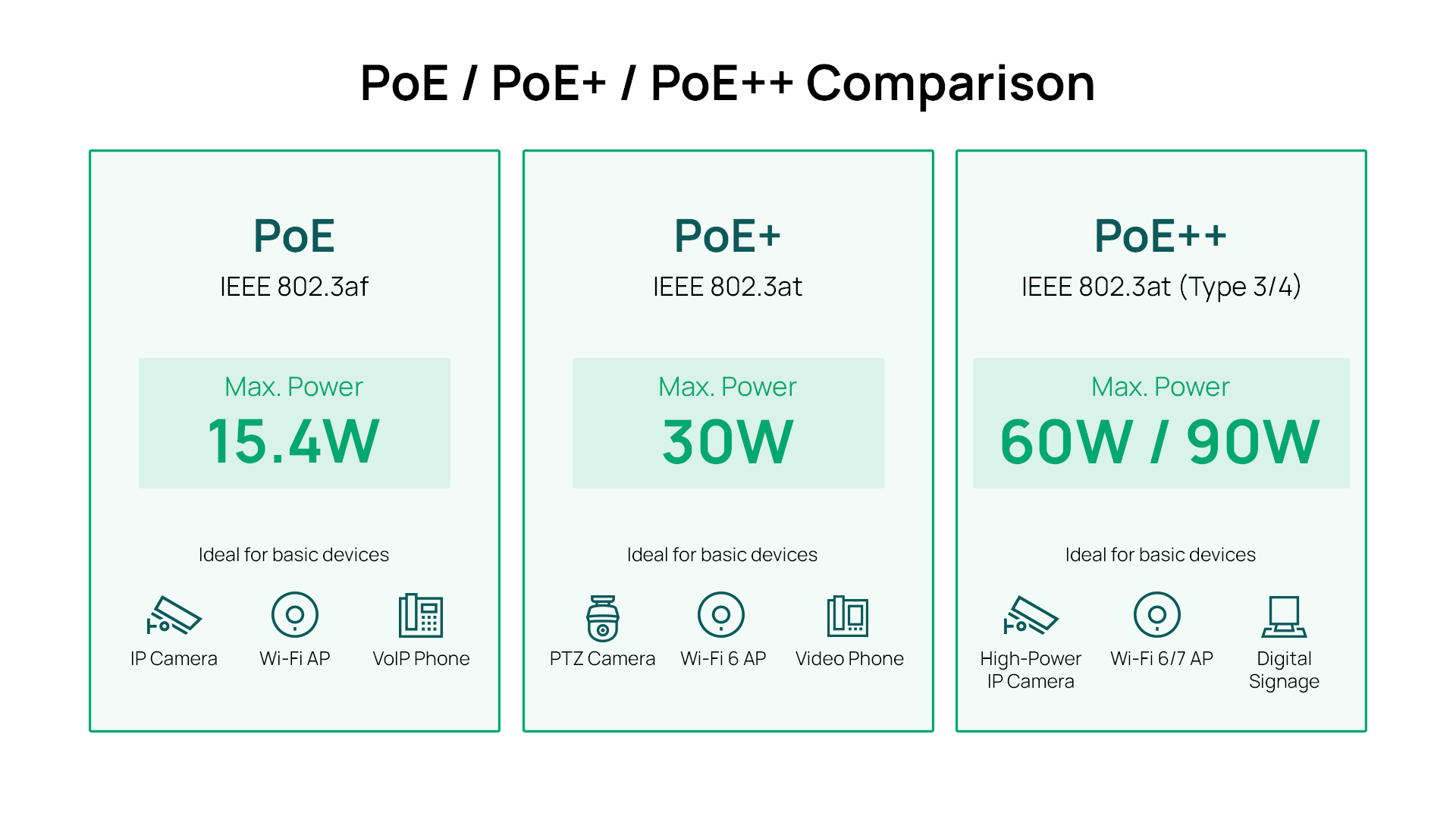
When you're deploying IP cameras, access points, or VoIP phones, PoE vs. PoE+ vs. PoE++ is one of the first decisions you'll face. Power over Ethernet (PoE) is the technology that delivers both electrical power and data over a single Ethernet cable, and the three IEEE standards differ significantly in how much power they provide: PoE (802.3af) delivers up to 15.4W at the source, PoE+ (802.3at) delivers up to 30W, and PoE++ (802.3bt) delivers up to 60W (Type 3) or 90W (Type 4) per port. Choosing the wrong tier means either underpowering devices or overspecifying infrastructure.
This guide breaks down each standard's wattage, cable requirements, and device fit, so you can spec the right switch or injector the first time.
Key Takeaways
- PoE, PoE+, and PoE++ correspond to IEEE 802.3af, 802.3at, and 802.3bt, respectively: three generations of the same standard family that deliver progressively more power per Ethernet port.
- Maximum power at the source steps up from 15.4W (PoE) to 30W (PoE+) to 60W or 90W (PoE++ Type 3 and Type 4), with usable power at the device slightly lower after cable losses.
- PoE is backwards-compatible in one direction only: a PoE++ switch can power a PoE or PoE+ device, but a PoE switch cannot supply enough power for a PoE++ device.
- Device fit drives the decision: VoIP phones and basic cameras run on PoE; Wi-Fi 6 access points and PTZ cameras typically need PoE+; Wi-Fi 7 access points and high-power PTZ cameras often require PoE++.
- A managed PoE switch consolidates power and connectivity for multi-device deployments, while a single-port injector is the cost-effective fix when upgrading one device on existing non-PoE infrastructure.
What Is Power over Ethernet (PoE)?
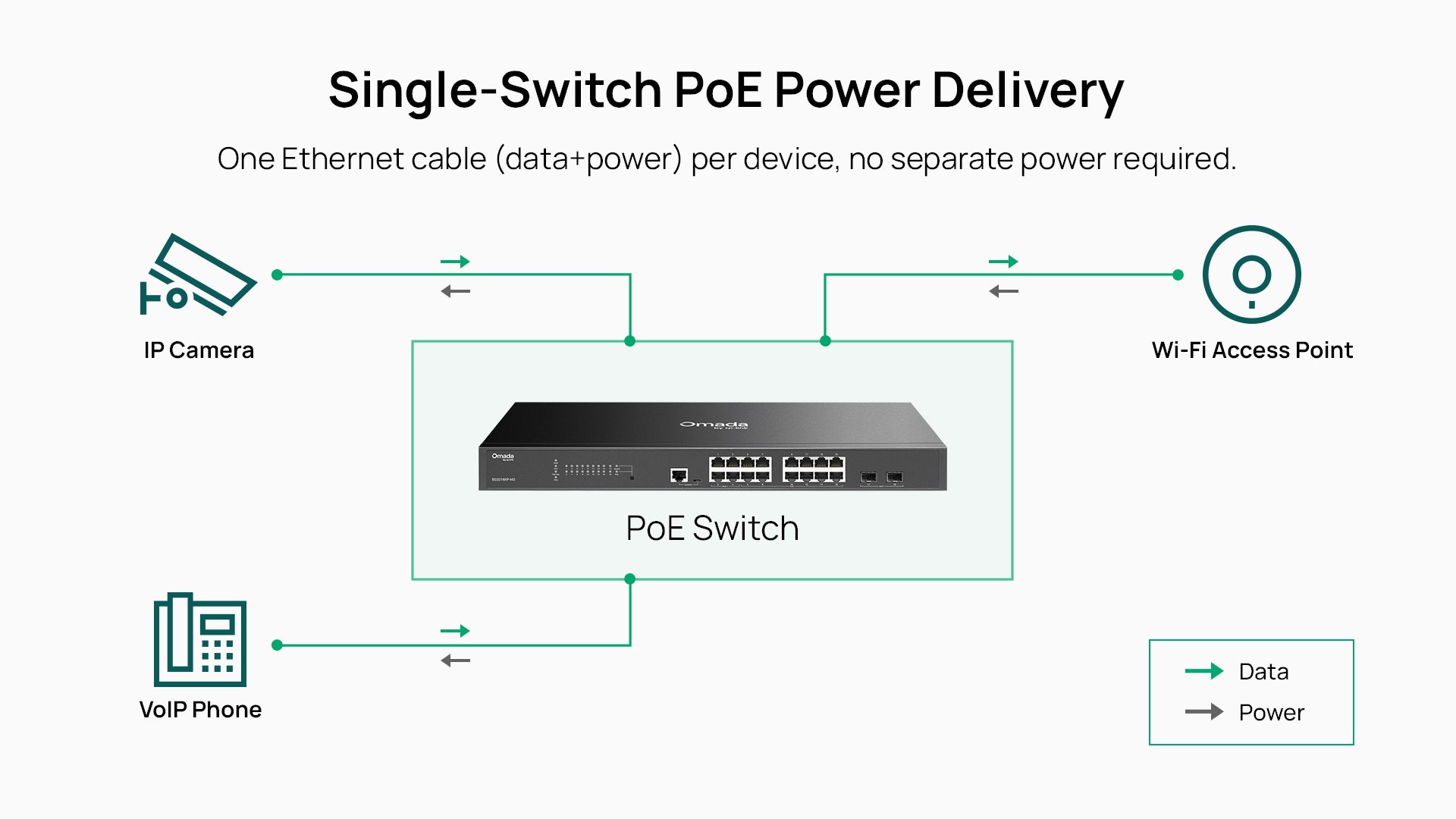
Power over Ethernet is a technology that delivers electrical power and data over a single Ethernet cable, eliminating the need for separate power adapters or outlets at each device location. The Power Sourcing Equipment (PSE) — typically a PoE switch or standalone injector — supplies the power. The Powered Device (PD) — the camera, access point, or phone — receives it. Before applying voltage, the PSE and PD perform detection and classification to confirm the device's power class and prevent damage to non-PoE equipment.
The operational benefit is straightforward: one cable run per device, no electrician needed for access point or camera placement, and the ability to manage and reboot devices remotely from the switch. The IEEE first ratified the PoE standard in 2003, and it has evolved through three generations to keep pace with higher-power devices. Each new generation preserves backwards compatibility on the cable side — Cat5e or better supports all three PoE standards.
PoE vs. PoE+ vs. PoE++: The Three IEEE Standards Explained
All three PoE types share the same fundamental approach — power and data over a single Ethernet cable — but each generation raises the power ceiling. The key differences are wattage, cable pair usage, and the class of devices each tier supports.
PoE (IEEE 802.3af)
Ratified in 2003, 802.3af is the original PoE standard. It delivers up to 15.4W at the PSE and up to 12.95W at the powered device, using two of the four twisted pairs in a Cat5e or better cable at 44–57V. This tier covers VoIP desk phones (3–7W), fixed indoor IP cameras without IR illumination (5–8W), and single-radio or older dual-band access points (10–13W).
PoE+ (IEEE 802.3at)
Ratified in 2009, 802.3at doubled the available power. PoE+ delivers up to 30W at the PSE and up to 25.5W at the device, still using two cable pairs at 50–57V. The higher ceiling covers Wi-Fi 5 and Wi-Fi 6 dual-band access points with 2×2 or 4×4 MIMO (15–25W), IP cameras with IR night vision or motorized lenses (10–25W), and video conferencing endpoints (12–25W). PoE+ is the most common standard in current SMB deployments.
PoE++ (IEEE 802.3bt)
Ratified in 2018, 802.3bt introduced two tiers under one standard. Type 3 delivers up to 60W at the PSE (51W at the device); Type 4 delivers up to 90W at the PSE (71.3W at the device). Both use all four twisted pairs — sometimes called 4PPoE — at 50–57V. "PoE++" is a marketing term encompassing both Type 3 and Type 4; when evaluating equipment, verify which type it supports, as the wattage difference is significant.
This tier is required for Wi-Fi 7 access points with tri-band radios (30–60W), PTZ cameras with heaters or wipers (30–60W), and large-format digital signage or high-draw POS terminals (up to 90W).
PoE vs. PoE+ vs. PoE++ Comparison Table
| Standard | IEEE Designation | Year Ratified | Max Power at PSE | Max Power at PD | Voltage Range | Cable Pairs Used | Typical Devices |
| PoE | 802.3af |
2003 |
15.4W | 12.95W | 44-57V | 2 of 4 | VoIP phones, basic cameras, single-radio APs |
| PoE+ | 802.3at | 2009 | 30W | 25.5W | 50-57V | 2 of 4 | Wi-Fi APs, IR cameras, video conferencing |
| PoE++ Type 3 | 802.3bt | 2018 | 60W | 51W | 50-57V | 4 of 4 | Wi-Fi 7 APs, PTZ cameras, enterprise APs |
| PoE++ Type 4 |
802.3bt |
2018 | 90W | 71.3W | 50-57V | 4 of 4 | Digital signage, high-draw POS, high-power PTZ |
Each generation roughly doubles available power, and all three standards run on the same Cat5e cable. The difference is what happens inside that cable: PoE and PoE+ use two of the four wire pairs, while PoE++ uses all four. That's why a switch or injector needs an explicit 802.3bt rating to support PoE++ devices; a PoE+ switch physically can't deliver the power, even if the port looks identical.
Backwards Compatibility: Which PoE Standards Work Together?
PoE is backwards-compatible: a higher-standard switch can power a lower-standard device, but not the other way around. A PoE++ switch will safely deliver the right wattage to a PoE phone or PoE+ access point. A PoE switch cannot power a PoE++ device that requires 60W or 90W, even if the cable and port physically connect.
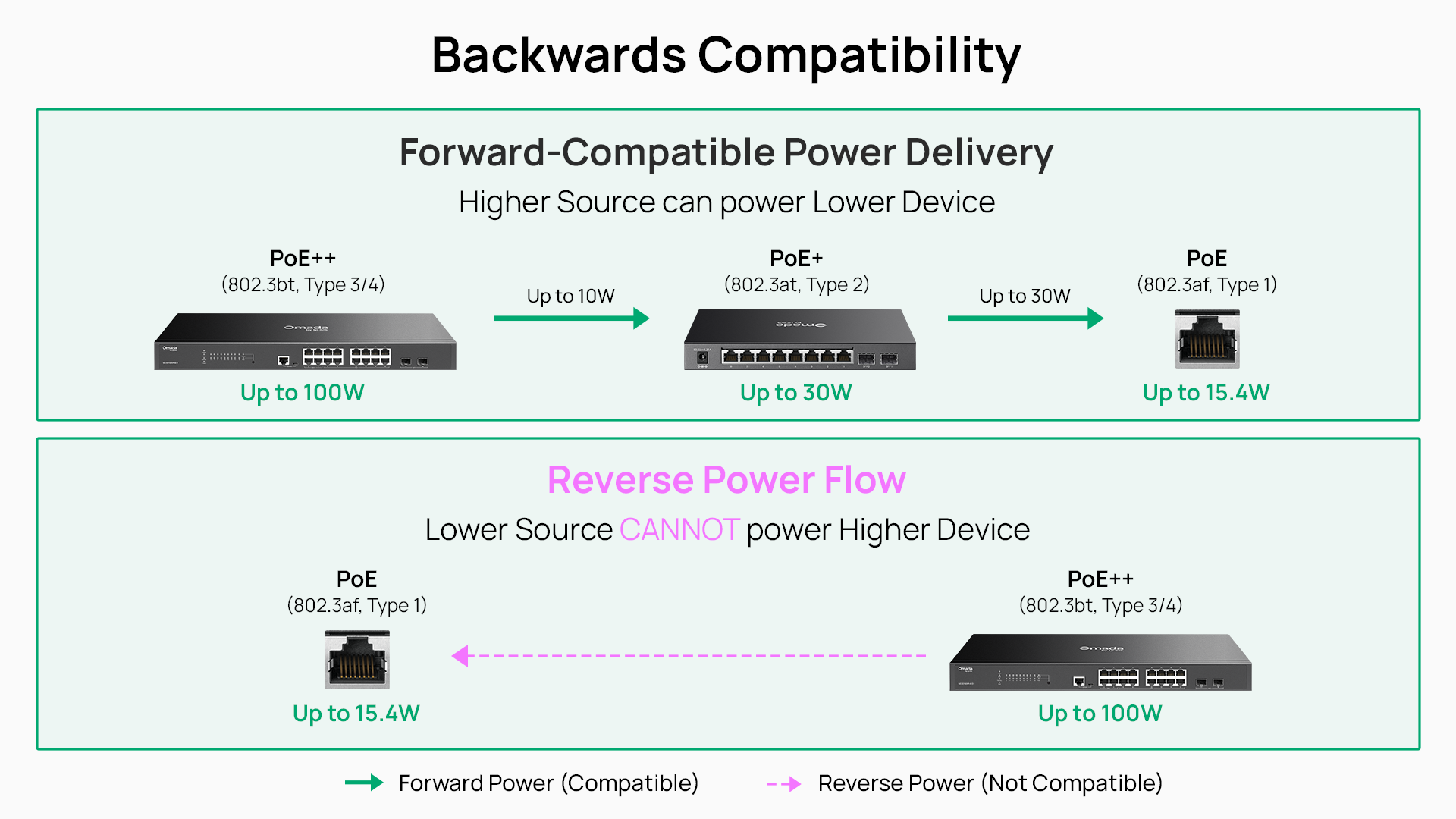
The power negotiation is what makes this safe. Before applying voltage, the PSE uses resistor-based classification and, in newer devices, LLDP-MED to identify the connected device's power class and apply only the required wattage. A PoE++ switch will safely deliver 7W to a VoIP phone or 20W to a Wi-Fi 6 access point without overloading either.
The same negotiation can't compensate in the other direction. A 15.4W PoE switch physically cannot supply a PoE++ device that requires 60W: the device will either fail to power on or operate in a degraded state. When upgrading a network to include Wi-Fi 7 access points or high-draw PTZ cameras, the switch is the upgrade decision point, not the cable.
Common PoE Uses by Device Type
The device, not the switch, should drive the PoE decision. Start with the highest-power device on the network: that draw sets the minimum tier for every switch and injector in that location.
Devices Powered by PoE (802.3af)
The 15.4W ceiling suits devices with low, stable power draws: VoIP desk phones (3–7W), fixed indoor IP cameras without IR illumination (5–8W), single-radio or older dual-band access points (10–13W), and wireless clocks, environmental sensors, and simple IoT controllers.
Devices Powered by PoE+ (802.3at)
The 30W ceiling covers the majority of current business networking devices: Wi-Fi 5 and Wi-Fi 6 dual-band access points with 2×2 or 4×4 MIMO (15–25W); IP cameras with IR night vision, motorized lenses, or onboard analytics (10–25W); and video conferencing endpoints and IP intercoms (12–25W).
Devices Powered by PoE++ (802.3bt)
The 60–90W range supports the highest-draw devices: Wi-Fi 7 access points with tri-band radios (30–60W); PTZ cameras with heaters, wipers, or extended IR (30–60W); outdoor access points with auxiliary radios (up to 60W); and large-format digital signage or high-draw POS terminals (up to 90W in Type 4 deployments).
PoE Switch vs. PoE Injector: Which Should You Use?
Both PoE switches and PoE injectors function as PSEs, but they solve different deployment problems. A PoE switch provides native PoE across multiple ports with a shared power budget, per-port monitoring, and centralized management. It’s the right fit for any deployment powering multiple devices. A managed PoE switch adds PoE auto-recovery, port isolation, VLAN assignment, and cloud visibility, which are particularly valuable in surveillance and multi-tenant environments.
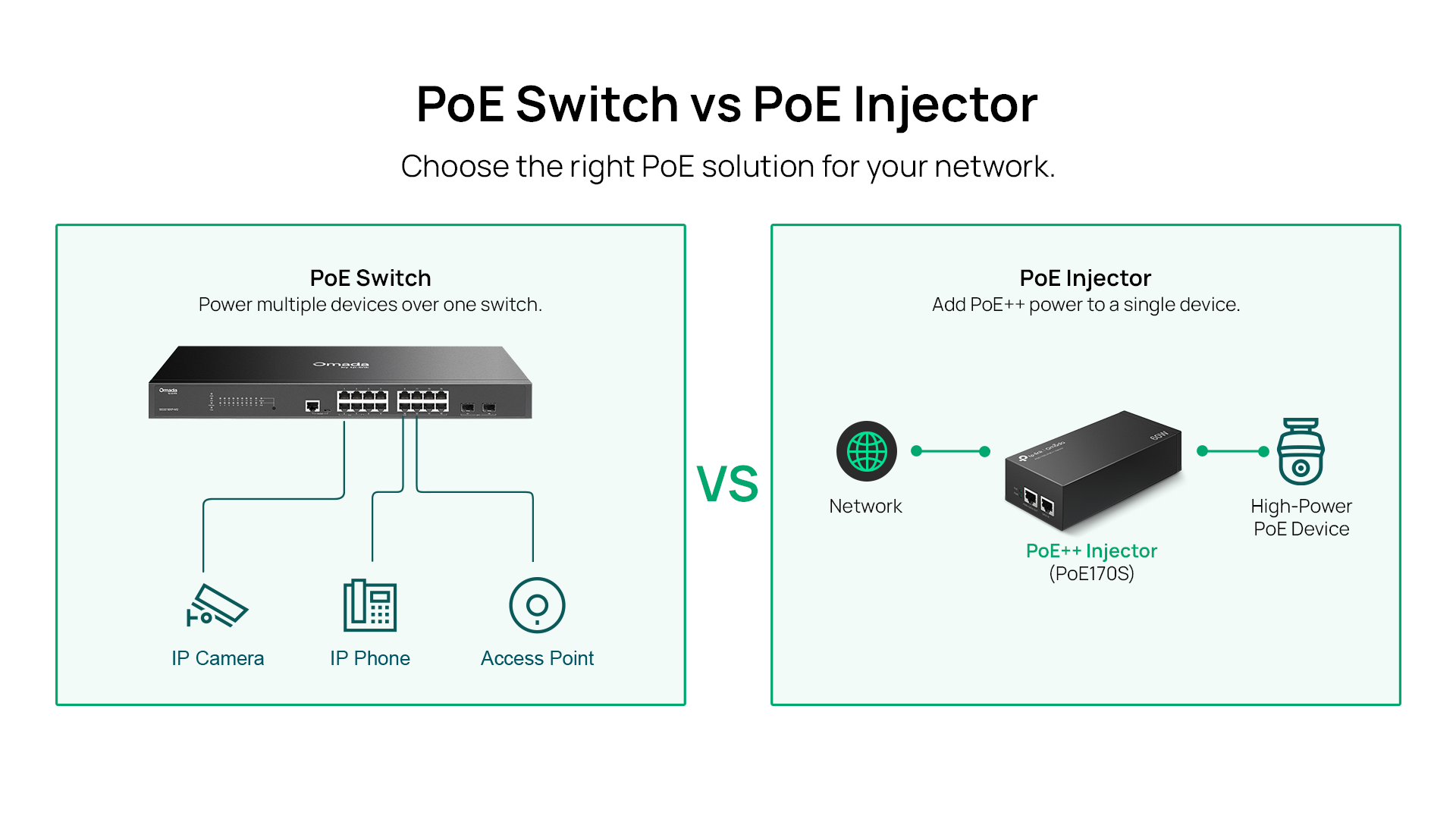
A PoE injector adds PoE to a single port on an existing non-PoE switch. It draws AC power and injects PoE onto the cable between the switch and the device. It's the cost-effective option for adding one or two PoE devices without replacing infrastructure. A practical rule: three or more PoE devices points toward a switch; one or two is often better served by an injector.
Power budget planning matters at the switch level. Total PoE capacity is shared across all active ports: a 24-port switch with a 250W budget cannot simultaneously deliver 25.5W to all 24 ports. Sum the realistic concurrent draw of all connected devices and build in headroom.
Omada PoE switches support deployments from small branch offices to larger managed environments. For single-device upgrades, the POE170S PoE++ injector delivers up to 60W to a single PoE++ device, and the POE160S PoE+ injector delivers up to 30W for PoE+ devices.
The full Omada PoE adapters collection includes injectors, splitters, and extenders across PoE tiers.
How to Choose the Right PoE Standard for Your Network
Step 1: Identify the highest-power device on the network. That means now and in the next two to three years. That device's draw sets the floor for the switch's per-port rating. A network being built for Wi-Fi 6 today may need to support Wi-Fi 7 at the next refresh.
Step 2: Match per-port and total power budget. The switch's per-port rating must meet or exceed the highest-draw device. The total budget must cover realistic concurrent device loads with headroom for additions.
Step 3: Confirm cable run distances. All three PoE standards deliver power over a maximum of 100m (328 ft) per cable segment. Select Omada PoE switches include an Extend Mode that stretches PoE transmission to 250m (820 ft) — useful for cameras on long runs — though port speed reduces to 10 Mbps in that mode.
Step 4: Choose managed or unmanaged. For multi-device environments, surveillance networks, or MSP-managed sites, a managed PoE switch adds remote visibility, PoE auto-recovery, port isolation, and VLAN-level control that unmanaged hardware can't match. See the guide on choosing switches for your surveillance system for a deeper look at those deployment decisions.
Omada managed switches support PoE+, PoE++, and multi-gigabit configurations through the Omada controller, alongside your access points and gateways.
Specifying the Right PoE Infrastructure for Your Deployment
PoE (802.3af) at 15.4W, PoE+ (802.3at) at 30W, and PoE++ (802.3bt) at 60W (Type 3) or 90W (Type 4) — the decision comes down to the highest-power device on the network. Spec the switch to match that device, build in headroom for the next technology cycle, and treat the switch as the upgrade point when device requirements grow.
For most deployments, a managed PoE+ or PoE++ switch handles the full range of cameras, access points, and VoIP devices while giving administrators the per-port visibility and control that unmanaged hardware can't provide.
Explore Omada PoE switches to find the right per-port and total budget for your deployment. For single-device additions to non-PoE infrastructure, the Omada PoE adapters collection includes PoE, PoE+, and PoE++ injectors.
Frequently Asked Questions
Is PoE++ backwards compatible with PoE+ and PoE?
Yes. A PoE++ (802.3bt) switch can power PoE (802.3af) and PoE+ (802.3at) devices at their appropriate lower wattage. The reverse is not true: a PoE or PoE+ switch cannot supply a device that requires 60W or 90W.
What is the difference between PoE+ and PoE++ (and what about “PoE+++”)?
PoE+ (802.3at) delivers up to 30W using two cable pairs; PoE++ (802.3bt) delivers up to 60W (Type 3) or 90W (Type 4) using all four pairs. The practical gap between them is significant: PoE++ can power device classes that PoE+ simply can't reach. As for "PoE+++": it has no IEEE definition and no standardized wattage. Some vendors use it to describe high-wattage proprietary implementations or to market Type 4 (90W) products. When evaluating equipment, the IEEE designation — 802.3af, 802.3at, or 802.3bt Type 3 or Type 4 — is the only spec that tells you what a device will actually deliver.
Do I need PoE or PoE+ for my access points and IP cameras?
It depends on the device. Most modern Wi-Fi 6 dual-band access points draw 15–25W and require PoE+. Basic fixed cameras without IR can run on PoE at 5–8W. Cameras with IR, motorized lenses, or analytics typically need PoE+. Check the device datasheet for the required IEEE standard or wattage draw.
What devices require PoE++?
Any device with a power draw exceeding 30W requires PoE++. Common examples include Wi-Fi 7 access points (30–60W), PTZ cameras with heaters or wipers (30–60W), outdoor access points with auxiliary radios, and large-format digital signage or advanced POS terminals (up to 90W in Type 4 deployments).
How far can PoE deliver power over a single Ethernet cable?
All three PoE standards support a maximum of 100m (328 ft) per cable segment. Select Omada PoE switches include an Extend Mode that reaches 250m (820 ft), though port speed reduces to 10 Mbps in that mode. A PoE extender placed mid-run can extend standard-speed runs beyond 100m.
Can I use a PoE switch to connect a non-PoE device?
Yes. The PSE completes a detection process before applying power and delivers power only to devices that identify themselves as PoE-capable PDs. Standard wired devices such as laptops, wired PCs, and non-PoE phones can connect to PoE switch ports without any risk.
What's the difference between PoE Type 3 and Type 4?
Both are defined under IEEE 802.3bt (PoE++), and both use all four cable pairs. Type 3 delivers up to 60W at the PSE (51W at the device); Type 4 delivers up to 90W (71.3W at the device). When a product is listed as "PoE++," check whether it supports Type 3, Type 4, or both — the difference matters for high-draw devices.